Key Takeaways
- AI Engine Trust: AI search engines (LLMs) like ChatGPT, Claude, and Perplexity don’t just scrape raw web pages; they cross-verify business facts across multiple data aggregators and local directories to establish entity trust.
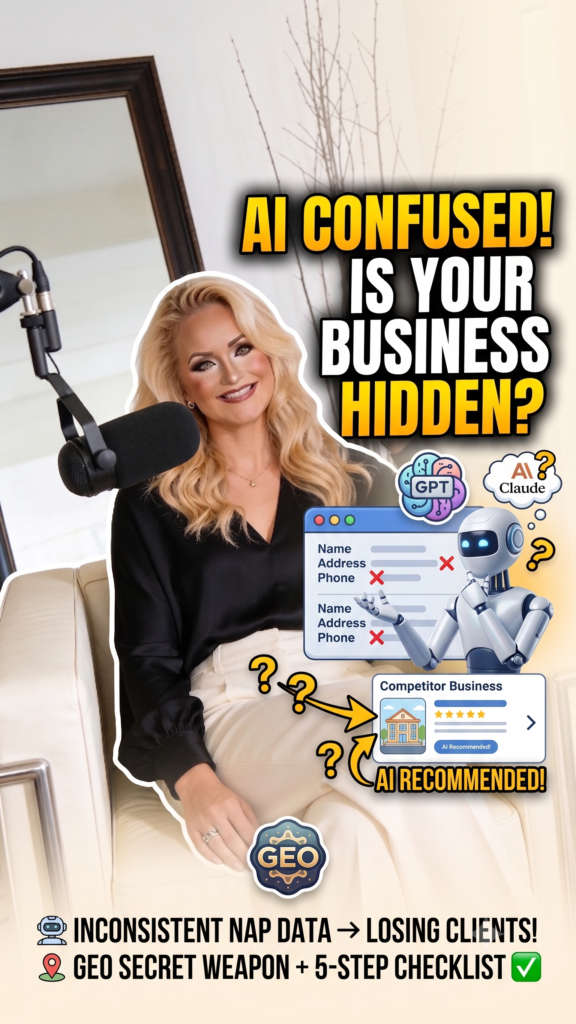
- The NAP Foundation: Name, Address, and Phone number (NAP) discrepancies cause “entity confusion,” causing AI models to pass over your business for a more verified competitor.
- GEO is the New Local SEO: Generative Engine Optimization relies heavily on un-corrupted structured citations, active Google Business Profiles, and hyper-local directory footprints.
- Turnkey Citation Management: Citation cleanup and structured syndication are core components of our Gold Marketing Package, designed to make your local brand AI-ready.
What Happens When Someone Asks ChatGPT for a Local Recommendation?
When a prospective client opens ChatGPT, Perplexity, or Claude and types, “Who is the best commercial HVAC contractor near me?” or “Recommend a top-rated estate planning attorney in my city,” what is actually happening behind the scenes?
AI engines don’t guess. They construct an answer by verifying that a real, physical business exists at a specific location, operates with active authority, and possesses an unblemished reputation.
If your business information is split across the web—if your business name is listed as “Donnelly & Associates LLC” on Yelp, “Donnelly Marketing Group” on Facebook, and “Business Solutions Marketing” on an old local chamber page—AI models hit a wall. They encounter what data scientists call entity ambiguity.
When an AI engine isn’t 100% sure your business data is accurate, it won’t risk giving a hallucinated or incorrect answer to the user. Instead, it simply skips your business and recommends your closest competitor who has crisp, matching, and verified data everywhere.
Why Are Local Citations the Key to AI Recommendations?
For over a decade at Business Solutions Marketing Group, we’ve watched local search evolve. In the early days, getting cited on directory sites was just about building backlink volume for traditional Google ranking. Today, citations perform a critical second job: they serve as the ground-truth verification layer for Large Language Models (LLMs).
AI platforms pull real-time location data from primary data aggregators (like Data Axle, Neustar Localeze, and Factual/Foursquare), search engine indexes, and structured business directories.
[ Your Business Data ]
│
├──> Data Aggregators (Data Axle, Localeze)
├──> Primary Networks (Google Business Profile, Apple Maps, Bing Places)
└──> Hyper-Local & Tier-2 Directories (Yelp, YellowPages, Chamber of Commerce)
│
▼
[ AI Verification & Entity Matching ]
│
▼
[ ChatGPT / Claude / Perplexity Recommendation ]
When an AI model attempts to validate whether your business is real, active, and trustworthy, it conducts a rapid cross-reference across these databases:
- Entity Resolution: The AI merges signals from yellow page networks, map databases, and niche directories into a single conceptual profile for your brand.
- Confidence Scoring: High NAP consistency yields a high confidence score. Inconsistent addresses or disconnected phone numbers drive down that score.
- Contextual Retrieval: The AI matches your specific services and geographic coverage directly to the user’s prompt.
If you want to read deeper on how structured web metadata influences AI comprehension, review Schema.org’s LocalBusiness Documentation or explore how search platforms evaluate entity trust in the Google Search Quality Rater Guidelines.
Is NAP Consistency Really Still That Important?
Yes! In fact, it’s more critical now than during the early days of map optimization.
NAP stands for Name, Address, and Phone Number.
Consider what happens with minor data corruption across directory networks:
- Directory A: 100 Main St, Suite 200 | (555) 019-2831
- Directory B: 100 Main Street #200 | (555) 019-2831
- Directory C: 100 Main Street (Old phone number from 3 years ago)
To a human, Directory A and Directory B are clearly the same place. But to an automated AI crawling process attempting to build high-precision vector embeddings, that discrepancy introduces noise.
If Directory C contains an obsolete phone number or outdated address, the AI’s confidence score drops. The engine flags the record as potentially stale or inaccurate.
How Does Generative Engine Optimization (GEO) Work for Local Brands?
Generative Engine Optimization (GEO) is the practice of optimizing your brand’s digital presence so AI engines naturally select and cite your business when users search for solutions.
+——————————————————————+
| THE 4 PILLARS OF LOCAL GEO |
+——————————————————————+
| 1. NAP Data Consistency | Clean, unified data everywhere. |
| 2. Directory Breadth | Presence on core + niche directories. |
| 3. Uncontested Branding | Matching legal & operational names. |
| 4. Verified Reviews | Real feedback across multiple hubs. |
+——————————————————————+
When you maintain unified local citations:
- You eliminate hallucinated details: AI tools will state your exact address, operating hours, and service lists without confusing them with past locations or unrelated entities.
- You dominate geo-targeted prompts: When users ask for “the top-rated digital agency in my area,” your high entity confidence score pushes you to the top of the AI response list.
- You strengthen traditional Local Pack performance: Clean NAP data remains a fundamental ranking factor for Google’s traditional 3-Pack as well.
At Business Solutions Marketing Group, we specifically designed our Gold Marketing Package to tackle this exact foundation. The Gold Package delivers complete local citation building, cleanup of conflicting legacy listings, continuous NAP audit reporting, and full platform optimization across mapping networks and directories.
What Are the Steps to Build an AI-Ready Local Citation Footprint?
To ensure your business is positioned to capture AI search recommendations, follow this structured process:
1.Audit Existing Directory Footprints:Identify all legacy variations of your NAP data.
Run a comprehensive audit across primary aggregators and major local directories (Yelp, YellowPages, Bing Places, Apple Maps, Manta). Document every outdated phone number, old street address, or minor name variation.
2.Establish a Single Ground-Truth NAP Standard:Lock in your exact official formatting.
Define the precise spelling, punctuation, suite formatting, and primary phone number for your brand. Use this single template across every digital touchpoint without exception.
3.Claim and Verify Tier-1 Profiles:Secure your foundational search footprints.
Claim and fully complete your Google Business Profile, Apple Business Connect, Bing Places, and primary social platforms. Fill out every field, including categories, service areas, and business hours.
4.Clean Up Duplicate and Inconsistent Listings:Eliminate entity confusion for AI crawlers.
Submit deletion requests for duplicate profiles and update outdated citations across secondary and tertiary networks. Ensure legacy phone numbers are completely removed from active listings.
5.Syndicate Clean Data Across Niche Directories:Build hyper-local depth.
Submit your standard NAP info to industry-specific platforms, local chamber of commerce directories, and regional business associations to solidify local geographic authority.
Frequently Asked Questions
What are local citations in SEO?
Local citations are online mentions of your business’s Name, Address, and Phone number (NAP) on directory sites, review platforms, and mapping networks. They help search engines and AI models verify your physical location and operational legitimacy.
How do local citations influence ChatGPT and Claude recommendations?
AI engines crawl web data and structured directories to cross-verify that a business actually exists before recommending it. Consistent citations provide the high confidence score AI models require to suggest your business to users.
What does NAP consistency mean?
NAP consistency means ensuring your exact business Name, Address, and Phone number are spelled and formatted identically across every single online directory, social profile, and website listing.
Can a minor address discrepancy hurt my local search visibility?
Yes, variations such as using a wrong suite number, an outdated phone number, or inconsistent street abbreviations can cause entity confusion. This lowers your brand’s confidence score in both traditional search engines and AI recommendation systems.
Which online directories matter most for AI optimization?
The primary platforms include Google Business Profile, Apple Maps, Bing Places, Yelp, Data Axle, Localeze, YellowPages, and relevant local Chamber of Commerce directories.
How often should local citations be audited?
We recommend conducting a full local citation audit at least twice a year, or immediately whenever your business changes physical locations, rebrands, or updates its phone numbers.
What is Generative Engine Optimization (GEO)?
Generative Engine Optimization (GEO) is the strategy of optimizing your brand’s structured web data, content, and citation footprints so AI engines like ChatGPT, Claude, and Perplexity feature your business in generated search responses.
How long does it take for citation cleanup to impact AI recommendations?
Directory platforms and AI web crawlers usually index updated citation data within 30 to 90 days, depending on crawler frequency and data aggregator update cycles.
Is citation building included in marketing agency management?
Yes! Our Gold Marketing Package includes comprehensive local citation building, listing cleanup, and ongoing NAP management to ensure your business stays visible across maps and AI search tools.
What happens if I have duplicate listings on major directories?
Duplicate listings dilute your authority score and send conflicting signals to search crawlers. Merging or removing duplicates is essential for maintaining clear entity signals for AI search tools.
About the Author
Linda Donnelly is the founder and owner of Business Solutions Marketing Group. With over a decade of hands-on experience helping small and medium-sized businesses scale, Linda specializes in turning complex digital marketing challenges into clear, revenue-driving strategies. Through tailored SEO, local citation management, and cutting-edge digital campaigns, her agency helps local businesses build lasting online authority.
GBP LInk – https://share.google/C8gU1JB3P6mPKWplN
LinkedIn – https://www.linkedin.com/company/business-solutions-marketing-group-llc/?viewAsMember=true
Instagram – https://www.instagram.com/business_solutions_mg/
Twitter – https://x.com/BSMGLLC
Facebook – https://www.facebook.com/BusinessSolutionsMarketingGroup
BlueSky: https://bsky.app/profile/bussolutions.bsky.social
TikTok – https://www.tiktok.com/@linda_donnelly
YouTube – https://www.youtube.com/channel/UC4w357-txvxOaHff2hTfSSg