Ninety-four percent of consumers will entirely avoid a business after reading just a single scathing, negative review.
If you are reading this, you probably already know the sheer panic of watching a fake, unfair, or defamatory one-star rating sabotage your hard-earned reputation. And if you are like most of the clients we work with here at Business Solutions Marketing Group, you took immediate action. You logged into your personal Gmail account, found the offending review, clicked the three little dots, and hit “Flag as inappropriate.”
Then, you waited. And waited.
Nothing happened.
I’m Linda Donnelly, and over the past decade of running Business Solutions Marketing Group, I’ve seen this exact scenario play out thousands of times. Business owners desperately try to clear their name using Google’s front-facing tools, only to be met with automated rejections or absolute silence.
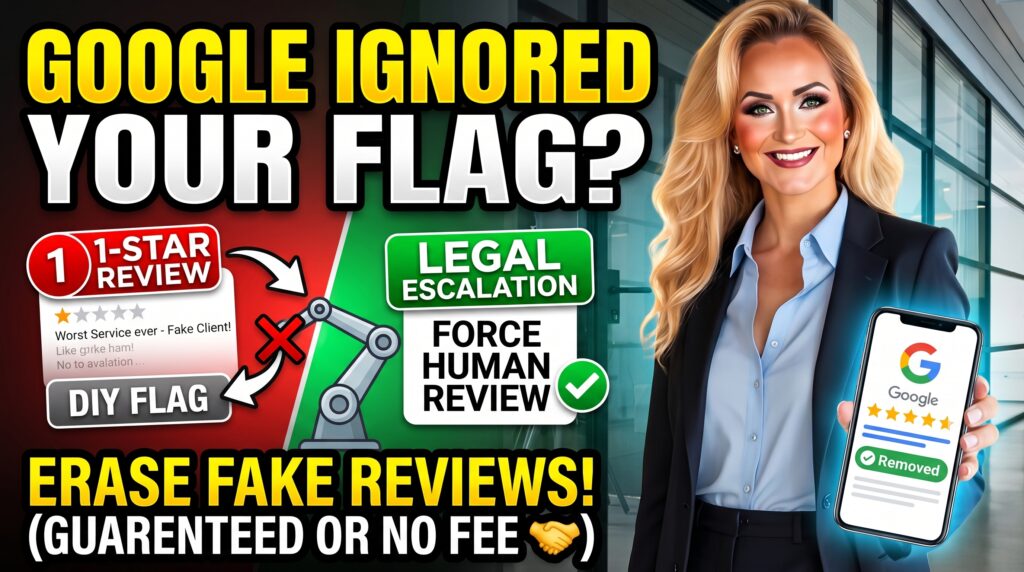
Let me be brutally honest with you: appealing to Google’s algorithm requires an expert because the system is actively designed to ignore you. Let’s break down exactly why the DIY approach fails, and how professional escalation actually clears your digital storefront.
Key Takeaways: Why You Need an Expert to Remove Google Reviews
- The “Flag” Button is a Placebo: Standard user flags are processed by AI, not humans. Unless the violation is cartoonishly obvious, the algorithm will reject it.
- Context is Everything: Google’s AI cannot read between the lines. It requires expertly framed arguments mapped directly to specific legal guidelines to trigger a manual, human review.
- Escalation requires specific pathways: Agencies use backend support channels, legal frameworks, and compliance terminology that average users don’t have access to or knowledge of.
- You shouldn’t pay for empty promises: True professionals operate on a performance basis. If the review doesn’t come down, you shouldn’t pay a dime.

Why Does the Standard “Flag as Inappropriate” Button Rarely Work?
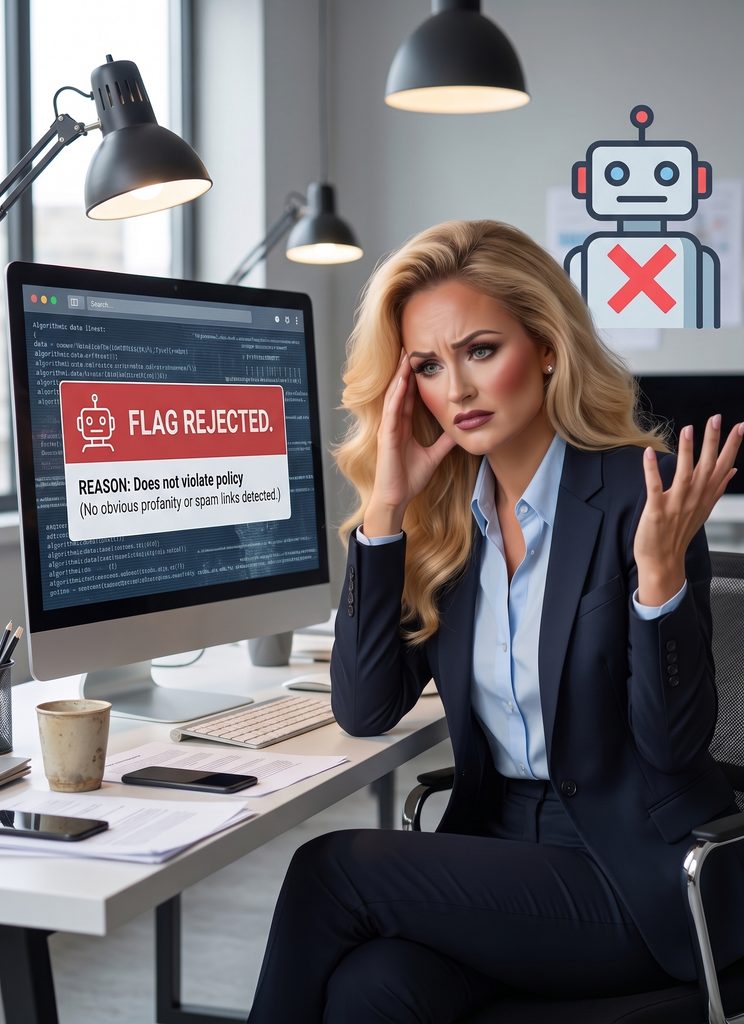
When you flag a review from a standard Gmail account, you are not speaking to a human. You are submitting a highly simplified form to Google’s tier-one machine learning algorithm.
According to Search Engine Journal’s analysis of local SEO mechanics, algorithms process millions of data points a second. This AI is trained to look for egregious, obvious policy violations—like blatant profanity, racial slurs, or spam links. If the malicious review you are trying to remove is simply a bitter competitor lying about a service they never received, the algorithm sees a perfectly normal block of text. It checks the IP address, scans for banned words, finds none, and automatically denies your request.
The AI doesn’t know your business. It doesn’t know that “John Smith” has never been in your database. It just knows that the text formatting looks normal. Hitting flag again won’t change its mind!
What Exactly Triggers a Manual Review at Google?
Getting a real, breathing human being at Google to look at a review is the holy grail of reputation management. But humans cost money, and Google processes thousands of complaints an hour. To force an escalation, you have to speak their language.
Our team has spent years dissecting Google’s Prohibited and Restricted Content policies. We don’t just say, “This review is fake!” We cite the exact subsection of the Terms of Service being violated. We compile metadata, cross-reference IP patterns, flag conflict-of-interest indicators, and build a localized case file. We know the exact combination of categorization and documentation required to bypass the bot and force a human moderator to open the ticket.
How Do Legal Frameworks Change the Review Removal Game?
Sometimes, terms of service violations aren’t enough. When a former employee decides to vent their frustrations by tanking your local ranking, or a competitor launches a coordinated defamation campaign, you have to elevate the strategy.
This is where DIY methods completely fall apart. An average business owner doesn’t know the difference between a standard policy violation and a legally actionable takedown request. Professionals understand how to structure formal complaints that touch upon defamation, copyright infringement, or targeted harassment in ways that force Google’s legal department to act.
Recent surveys from BrightLocal on consumer trust prove that consumers read an average of 10 reviews before feeling able to trust a business. You simply cannot afford to let legally removable slander sit on your profile because you didn’t know the correct legal pathway to submit the removal request.
Why Is a Zero-Risk, Pay-for-Performance Model the Ultimate Solution?
I get it. If you’ve been burned by a fake review, you are probably highly skeptical of anyone promising to fix it. The internet is full of “reputation managers” who charge high upfront retainer fees, send a few automated emails, and then shrug their shoulders when Google says no.
That is exactly why I built our Review Removal Service differently. We operate entirely with no risk to you—meaning you pay absolutely nothing until the review is permanently removed.
We take on the burden of proof. We do the heavy lifting, the backend escalations, and the persistent follow-ups. Because we rely on our deep understanding of Google’s algorithms and escalation procedures, we only win when you win. It’s that simple.
What Are the Most Frequently Asked Questions About Google Review Removal?
How long does Google take to process a flagged review? Google typically takes between 3 to 7 business days to process a standard review flag through their automated system.
- If approved, the review disappears immediately.
- If denied, you will receive an automated email, or the status will silently change in your management dashboard.
- Escalated appeals handled by professionals can take anywhere from a few days to several weeks depending on complexity.
Can anyone guarantee the removal of a Google review? No legitimate agency can legally guarantee the removal of every single Google review, as Google retains final editorial control.
- Beware of companies asking for upfront payments with “guarantees.”
- Look for pay-on-performance models where you only pay if the removal is successful.
- Valid, truthful negative reviews from real customers usually cannot be removed.
Why did Google reject my review removal request? Google usually rejects removal requests because the AI algorithm could not verify a clear Terms of Service violation within the text.
- The review may not contain prohibited language (slurs, spam, explicit content).
- The algorithm cannot verify offline facts (e.g., whether the person was an actual customer).
- The complaint was submitted without sufficient contextual evidence.
Does Google notify the person who left the review if it gets removed? No, Google does not send a notification or email to the user alerting them that their specific review has been removed.
- The user may notice it is gone if they actively check your profile.
- They are not penalized unless they are part of a massive bot network.
- Users technically can attempt to post a new review, though aggressive reposting often triggers spam filters.
Can a business sue someone over a fake Google review? Yes, a business can pursue legal action for defamation if they can prove a review is factually false and caused financial damage.
- You must be able to identify the reviewer (often requiring a subpoena).
- Opinions (e.g., “The food was terrible”) are protected under free speech.
- False statements of fact (e.g., “The owner stole my credit card”) are legally actionable.
How does an agency escalate a review removal differently than a business owner? Agencies bypass the standard “flag” button and use dedicated support channels, legal request forms, and specialized policy documentation.
- We cite specific sub-clauses of Google’s restricted content policy.
- We package metadata and proof of conflict of interest in a format Google’s manual review team prefers.
- We persistently manage the ticket through multiple layers of support.
What constitutes a conflict of interest in Google reviews? A conflict of interest occurs when a review is left by someone who has a biased relationship with the business.
- Reviews left by current or former employees.
- Reviews left by direct competitors.
- Reviews left by the business owner themselves (or family members) to inflate ratings.
Can I remove a review if the customer simply didn’t like the service? No, you cannot remove a review just because a customer had a genuinely bad experience and expressed their opinion.
- Google’s platform is designed to reflect real consumer experiences, both good and bad.
- Disagreements over service quality do not violate Google’s policies.
- The best approach for valid negative reviews is a professional public response and internal service improvements.
Will responding to a fake review make it harder to remove? Responding to a fake review does not prevent you from successfully getting it removed later.
- A calm, professional response shows prospective customers that you are attentive.
- Never argue or resort to name-calling in a response.
- State simply: “We have no record of doing business with you, please contact our office directly.”
How does a pay-on-performance review removal service work? A pay-on-performance service means the agency absorbs all the upfront labor and risk of the escalation process.
- The agency evaluates the review to ensure it violates policy.
- They execute the removal strategy.
- You are only invoiced after the review is completely gone from your Google Business Profile.
About the Author
Linda Donnelly is the founder and owner of Business Solutions Marketing Group. With over ten years of hands-on experience in digital marketing, local SEO, and reputation management, Linda specializes in helping small business owners protect their brands and grow their bottom lines through data-driven, strategic marketing solutions.
GBP LInk – https://share.google/C8gU1JB3P6mPKWplN
LinkedIn – https://www.linkedin.com/company/business-solutions-marketing-group-llc/?viewAsMember=true
Instagram – https://www.instagram.com/business_solutions_mg/
Twitter – https://x.com/BSMGLLC
Facebook – https://www.facebook.com/BusinessSolutionsMarketingGroup
BlueSky: https://bsky.app/profile/bussolutions.bsky.social
TikTok – https://www.tiktok.com/@linda_donnelly
YouTube – https://www.youtube.com/channel/UC4w357-txvxOaHff2hTfSSg