Key Takeaways
- AI Search Operates on Consensus: Large Language Models (LLMs) like ChatGPT, Claude, and Google Gemini do not rely on single-source rankings; they aggregate real-time data across multiple digital channels to verify business legitimacy.
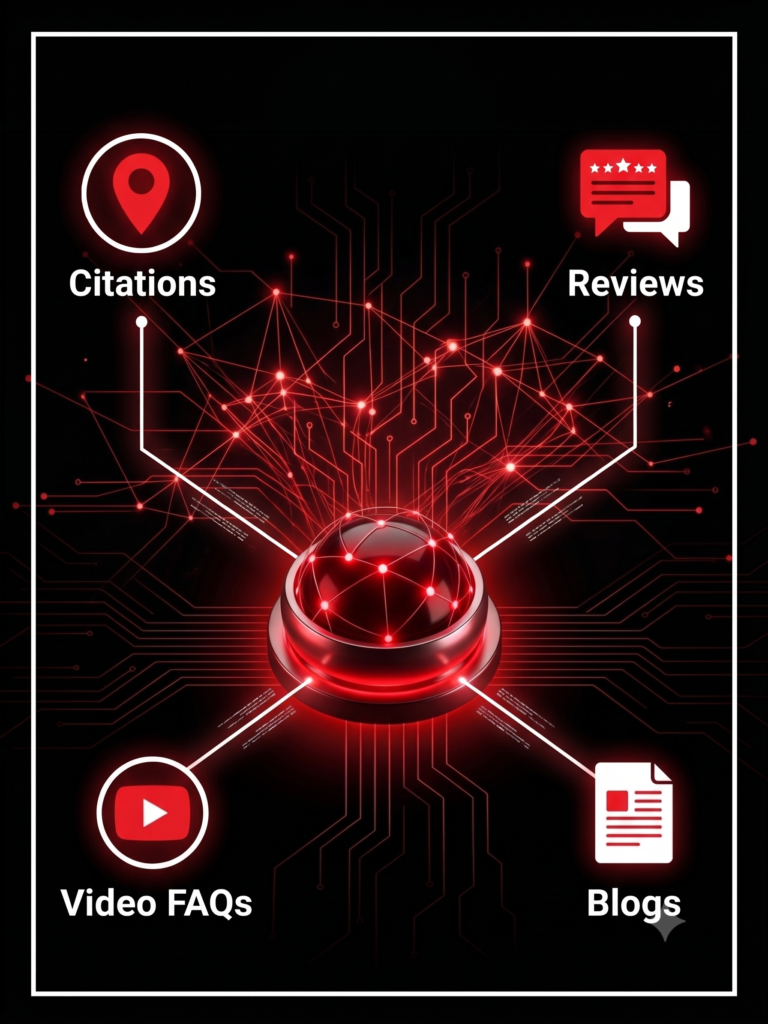
- The “Triad of AI Trust”: Combining consistent local citations, high-frequency video FAQs, and structured, topical blogs creates a cross-web validation loop that AI algorithms favor.
- Review Sentiment Matters: Continuous review generation provides the fresh entity data that LLMs use to gauge customer satisfaction and active operations.
- Omnipresence Drives Recommendations: The Gold Package from Business Solutions Marketing Group delivers the exact mix of content, local citations, review building, and social signals needed to rank inside AI Overviews.
“If the web doesn’t agree on who you are, AI will simply recommend the competitor it actually understands.”
When local business owners ask me why their search visibility dropped overnight, the answer usually comes down to a shift in how search works. Search engines no longer evaluate a standalone website in isolation; instead, AI models scour the entire web to evaluate the entity behind that website.
At Business Solutions Marketing Group, we have spent more than a decade helping local companies adapt to search shifts. Right now, the shift from traditional keyword matching to AI-driven entity synthesis is the largest transition we have ever managed. If your brand is not visible, consistent, and active across multiple platforms simultaneously, AI search models simply ignore you.
Here is a breakdown of how AI models establish brand trust, why multi-channel validation is non-negotiable, and how we built our Gold Marketing Package to deliver that exact digital footprint.
Why Do AI Search Engines Require Multi-Channel Verification?
Traditional search engines index pages based on keywords, backlinks, and technical site health. Modern Large Language Models (LLMs) operate differently: they synthesize information from across the web to construct a unified understanding of your business, known as an entity.
When a user asks Google Gemini or ChatGPT for the “best commercial electrician near me,” the AI model evaluates brand sentiment and cross-web consistency. It asks three core questions behind the scenes:
- Does this business exist in the physical world with identical details across all directories?
- Are real humans actively talking about and reviewing this business on third-party platforms?
- Does the business regularly produce authoritative, original content that solves real customer problems?
If the AI finds conflicting phone numbers on directory sites, an inactive social media page, or a website that has not been updated in six months, its confidence score drops. Lower confidence means your business gets left out of AI Overviews and conversational search results. Research published by the Pew Research Center highlights how rapidly consumer reliance on AI-driven information tools is accelerating, making early positioning critical for local market leaders.
+——————————————————————-+
| THE AI CONSENSUS LOOP |
+——————————————————————-+
| |
| [ Structured Blogs ] <——–> [ Local Citations & Directory ] |
| ^ ^ |
| | | |
| v v |
| [ Social & Video FAQs ] <—–> [ Fresh Customer Reviews ] |
| |
+——————————————————————-+
| RESULT: High Entity Confidence -> Priority AI Overview Placement|
+——————————————————————-+
What Is “Brand Consensus” and How Does It Trigger AI Overviews?
Brand consensus occurs when independent web sources present matching data about your business name, address, phone number, service list, and reputation.
Think of AI models as cautious researchers. If one source says you offer emergency plumbing in Philadelphia, but your social profiles list a suburban address without mentioning emergency services, the AI experiences ambiguity. To avoid giving users incorrect information, it skips your listing and highlights a competitor whose data aligns perfectly across every touchpoint.
To establish bulletproof brand consensus, your digital strategy must feed AI algorithms through four synchronized channels:
- Structured Long-Form Content: Detailed blogs that directly answer high-intent user questions using clear heading structures.
- Direct Consumer Feedback: Consistent stream of verified customer reviews that confirm ongoing, real-world business operations.
- Visual & Video Cues: Short video FAQs and media posts that prove active engagement and increase dwell time across social platforms.
- Directory Alignment: Clean, synced NAP (Name, Address, Phone) citations on major aggregator networks.
How Does Our Gold Package Build an Inescapable Digital Footprint?
We designed our Gold Marketing Package specifically to satisfy the strict consensus requirements of modern AI search algorithms. We don’t execute isolated tactics; we build an omnipresent digital footprint that forces search models to recognize your business as the category authority.
Here is how the core elements of the Gold Package work together to build that footprint:
+——————————————————————–+
| BSMG GOLD PACKAGE OMNIPRESENCE MODEL |
+——————————————————————–+
| CORE ELEMENT | PRIMARY AI SIGNAL GENERATED |
+————————+——————————————-+
| 4 Structured Blogs | Deep topical authority & structured data |
| Review Builder Plus | Fresh entity validation & sentiment |
| Local Citations | Geographic NAP consistency |
| 10 Social Posts | Real-time brand activity & social proof |
+——————————————————————–+
1. Four High-Intent, Structured Blog Posts
Every month, we publish four comprehensive, SEO-optimized articles tailored to your core services. We format these posts with clear question headings, concise answers, and direct schema-ready structures. This gives LLMs the exact semantic snippets they need to cite your business inside AI Overviews.
2. Review Builder Plus
Fresh reviews are the lifeblood of local AI recommendations. According to review research from BrightLocal, consumers and search algorithms place the highest value on reviews written within the last 90 days. Review Builder Plus automates customer review collection, ensuring a steady stream of positive, keyword-rich feedback on your Google Business Profile and key directory sites.
3. Comprehensive Local Citation Management
We audit, correct, and build your business listings across top directory networks and data aggregators. By eliminating duplicate entries and correcting mismatched NAP details, we eliminate data friction and boost the AI’s confidence score in your location data.
4. Ten Strategic Social Media Posts
AI models monitor real-time social signals to confirm that a business is active. We create and distribute ten targeted social posts monthly across your active platforms. This ongoing activity signals to search crawlers that your brand is operational and actively engaging with its local community.
When you bring these four elements together under our Business Solutions Marketing Group umbrella, you create a self-reinforcing network of brand signals that AI engines cannot ignore.
Frequently Asked Questions About AI Search & Local Rankings
What is the difference between traditional SEO and AI search optimization?
Traditional SEO focuses primarily on ranking a specific URL on a search engine results page using keywords and backlinks. AI search optimization focuses on establishing your entire business as a trusted entity across the web so LLMs recommend you in conversational answers.
- Traditional SEO: Keywords, page speed, backlink volume, meta tags.
- AI Optimization: Entity consistency, multi-channel consensus, review sentiment, structured schema markup.
Why are local citations still important for AI Overviews?
Local citations provide the foundational location and identity data that AI models cross-reference before making a local recommendation. If your NAP details vary across directories, AI engines penalize your local confidence score.
- Key Benefits: Fixes data conflicts, confirms operational status, reinforces physical service boundaries.
How often do AI search models update their understanding of my business?
AI models crawl high-authority directories, review platforms, and social feeds continuously. While broad core model training happens periodically, real-time web retrieval tools (like Google AI Overviews) pull live web data in seconds to answer user queries.
- Frequency: Real-time retrieval for active searches; weekly/monthly for broader web graph indexing.
Can customer reviews directly impact whether AI recommends my business?
Yes, customer reviews provide both sentiment analysis data and real-time operational proof for LLMs. AI models scan recent review text to verify specific services offered, staff professionalism, and overall customer satisfaction.
- Critical Metrics: Review freshness (under 90 days), response rate, keyword presence in customer feedback.
How does social media activity influence LLM search recommendations?
Social media channels are indexed by search engines and serve as active proof of life for your business entity. Regular posts create fresh indexed URLs and engagement signals that reinforce your brand’s authority.
- Key Signals: Post frequency, consistent branding across profiles, active audience interaction.
What is structured content and why do LLMs prefer it?
Structured content uses clear subheadings (like H2 and H3 tags), bulleted lists, direct summary tables, and schema markup to organize information. LLMs prefer structured text because it is easy to parse, extract, and cite inside direct answer boxes.
- Structure Essentials: Question-based headings, concise direct answers, supporting bullet points.
Why isn’t having a great website enough to rank in AI search results anymore?
A great website only represents what you say about yourself. AI models look for external confirmation—such as directory listings, social channels, news mentions, and third-party reviews—to validate your website’s claims.
- Core Requirement: Cross-web verification from independent platforms.
How does video content contribute to a multi-channel digital footprint?
Video content increases user engagement, extends dwell time, and provides rich transcript data that search engines index. Platforms like YouTube (owned by Google) feed direct video summaries and transcripts into search AI features.
- Best Uses: Short video FAQs, service walkthroughs, customer video testimonials.
What is “entity authority” in modern search engine optimization?
Entity authority is the measure of how well search algorithms understand, categorize, and trust a specific person, place, or business as an industry expert.
- Building Blocks: Verified listings, active content publishing, authoritative industry citations, positive customer sentiment.
How quickly can a business expect results after fixing its multi-channel footprint?
While directory syncs and search re-indexing can take 30 to 90 days, businesses often see improvements in local AI visibility within weeks of resolving NAP discrepancies and activating consistent review collection.
- Timeline: Initial citation sync (30 days), review acceleration (30-60 days), full AI consensus impact (60-90 days).
About the Author
Linda Donnelly is the founder and owner of Business Solutions Marketing Group, where she has helped local small businesses scale through strategic, high-ROI digital marketing for over a decade. Combining deep expertise in search engine optimization, local marketing, and emerging AI search architecture, Linda designs multi-channel programs that turn local businesses into market leaders. When she isn’t analyzing search algorithms or building growth strategies for clients, you can usually find her on the local tennis courts or spending time with her growing family.
GBP LInk – https://share.google/C8gU1JB3P6mPKWplN
LinkedIn – https://www.linkedin.com/company/business-solutions-marketing-group-llc/?viewAsMember=true
Instagram – https://www.instagram.com/business_solutions_mg/
Twitter – https://x.com/BSMGLLC
Facebook – https://www.facebook.com/BusinessSolutionsMarketingGroup
BlueSky: https://bsky.app/profile/bussolutions.bsky.social
TikTok – https://www.tiktok.com/@linda_donnelly
YouTube – https://www.youtube.com/channel/UC4w357-txvxOaHff2hTfSSg