By the time you finish reading this sentence, several thousand unique prompts will have been typed into ChatGPT, Perplexity, and Claude. Here is the kicker: according to research from Ahrefs, nearly 95% of keywords get 10 or fewer searches per month in traditional search (Source). In the world of AI, that fragmentation is even more extreme. If you are still waiting for a “Prompt Volume” tool to tell you what to write, you aren’t just late—you’re invisible.
Hi, I’m Linda Donnelly. I’ve spent the last decade at Business Solutions Marketing Group helping small businesses navigate the messy, ever-changing waters of digital marketing. I’ve seen the transition from keyword stuffing to “quality content,” and now, we are facing the biggest shift of our lives: the move from Search Engines to Answer Engines.
Everyone is asking me the same two things: “How do I rank in ChatGPT?” and “What are people typing in?”
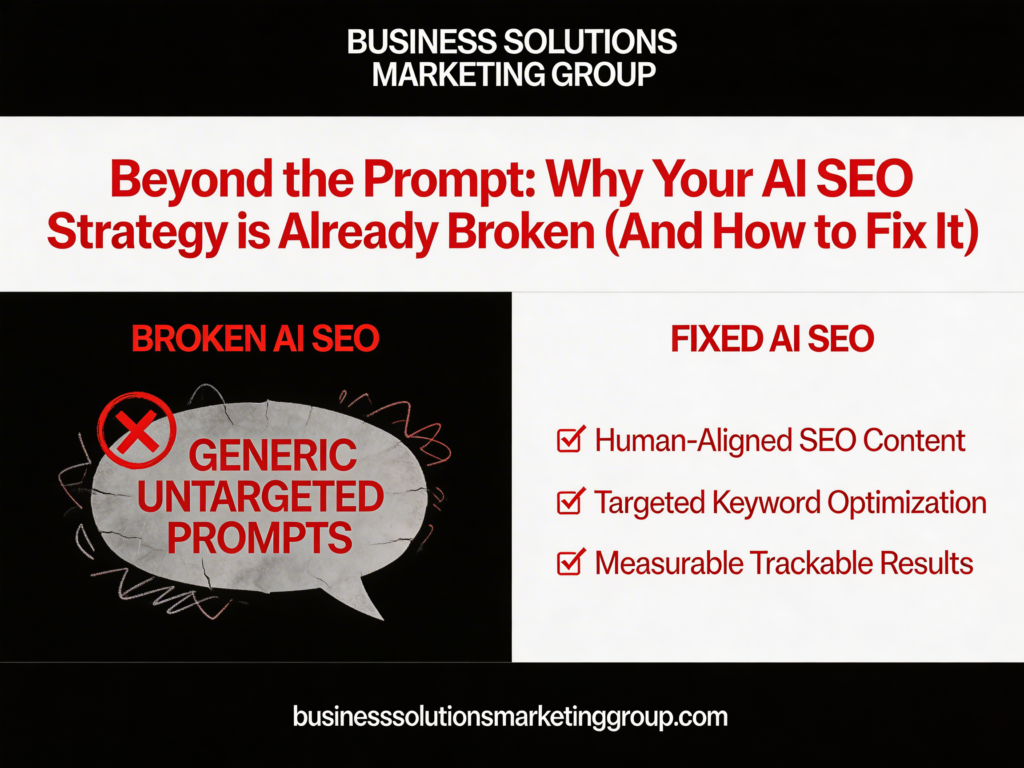
I’m going to be blunt. If you’re building your strategy around prompt volume, you’re chasing ghosts. AI search doesn’t have a clean list of keywords. It doesn’t have consistent query data. Why? Because most AI prompts never repeat the same way twice. People talk to AI like a human, not a search bar.

The Death of the Keyword and the Birth of Context
In the old days of Google (you know, three years ago), we optimized for “Plumber in Minneapolis.” Now, a user tells an AI: “I have a leak behind my fridge, I’m worried about mold, and I need someone who can come out after 6 PM and doesn’t charge a fortune for the weekend.”
There is no “keyword” for that. There is only intent and context.
According to BrightEdge, AI Overviews (SGE) now show up for over 84% of search queries across certain industries (Source). These AI engines aren’t looking for a word match. They are looking for the most authoritative, deeply structured answer to a specific problem.
Why Prompt Volume is a Losing Game
- Infinite Variations: No two people describe a problem the same way to a chatbot.
- Zero Persistence: Keywords used to last for years. AI conversations evolve in real-time.
- Data Lag: By the time a prompt shows “high volume” in a tool, the AI has already moved on to a more nuanced understanding of the topic.
The Pivot: Optimize for Problems, Not Prompts
So, how do you actually win? You stop trying to match words and start trying to solve problems deeply. This is a concept I call Problem-Context Optimization.
1. Cover the “Underlying Intent”
Instead of writing ten short blogs for ten different keywords, write one definitive guide that covers the “Problem Ecosystem.” If you sell commercial insurance, don’t just write about “rates.” Write about the fear of litigation, the confusion of state-specific mandates, and the stress of a claim. Address the feelings behind the prompt.
2. Structure for Extraction
AI engines don’t “read” like we do; they “extract.” Use clear H2 and H3 tags. Use bullet points. Use schema markup. If an AI can’t find your answer in 0.2 seconds, it will cite your competitor who made it easier to skim.
3. Provide “Proof of Authority”
Backlinko reports that the average Google first-page result contains 1,447 words (Source). In AI SEO, length matters less than density. AI loves data points, original quotes, and unique insights that can’t be found in a generic Wikipedia entry.
How We Solve This: The Gold Marketing Package
At Business Solutions Marketing Group, we realized early on that small business owners don’t have 40 hours a week to study AI LLM (Large Language Model) behavior. That’s why we built our Gold Marketing Package.
We don’t just “do SEO.” We build a content fortress. We take your expertise and structure it specifically so that AI engines like ChatGPT and Google Gemini see you as the only logical source to cite. We handle the deep topic coverage, the technical structure, and the context-mapping that actually drives traffic in 2024 and beyond.
Check out how we do it here: BSMG Marketing Packages.
💡 Key Takeaways
- Abandon the Search Volume Obsession: It doesn’t exist in the same way for AI.
- Focus on Intent Clusters: Group similar problems together rather than chasing single words.
- Be the “Citable” Source: Use data, lists, and clear structures to encourage AI to link to you.
- Solve the “Bind”: Position your business as the relief to a specific, scary time for your customer.
FAQ: Common Questions About AI Search
1. Does traditional SEO still matter?
Yes, but it’s the foundation, not the house. AI uses traditional search indices to find information, so you still need a fast, mobile-friendly site.
2. How do I know if I’m ranking in AI?
Tools are emerging, but the best way is “vanity testing.” Ask ChatGPT or Perplexity about a problem your business solves and see if it mentions you!
3. What is “Contextual Relevance”?
It’s providing all the surrounding information an AI needs to understand your answer. If you’re a lawyer, don’t just give a price; explain the court process, the timeline, and the expected emotions.
4. Should I use AI to write my content?
You can use it for outlines, but never for the final product. AI-generated content is often “middle-of-the-road.” To rank in AI, you need human insight that the AI doesn’t already have.
5. How often should I post?
Quality over quantity. One deep-dive, high-context pillar post is worth 50 “keyword-optimized” fluff pieces.
6. What is a “Problem Ecosystem”?
It’s the collection of all the worries, questions, and side-effects related to a single customer problem.
7. Does the Gold Marketing Package include AI optimization?
Absolutely. It is baked into our entire content strategy.
8. Is “Prompt Engineering” for users only?
No! As a business, you need to “Reverse Prompt Engineer”—anticipating how an AI will look for your data.
9. Will AI replace Google?
It’s more likely they will merge. Google is already becoming an “Answer Engine.”
10. Why is my traffic dropping even if I’m “ranking”?
It might be “Zero-Click Searches.” The AI gives the answer on the page. To counter this, you must give the reader a reason to click through for a deeper tool, a consultation, or a specific result.