
By Linda Donnelly | Business Solutions Marketing Group
You just got a bad Google review. Maybe it showed up this morning. Maybe someone sent you a screenshot. Maybe you happened to Google your own business and there it was — sitting at the top of your profile, one or two stars, and a complaint that made your stomach drop.
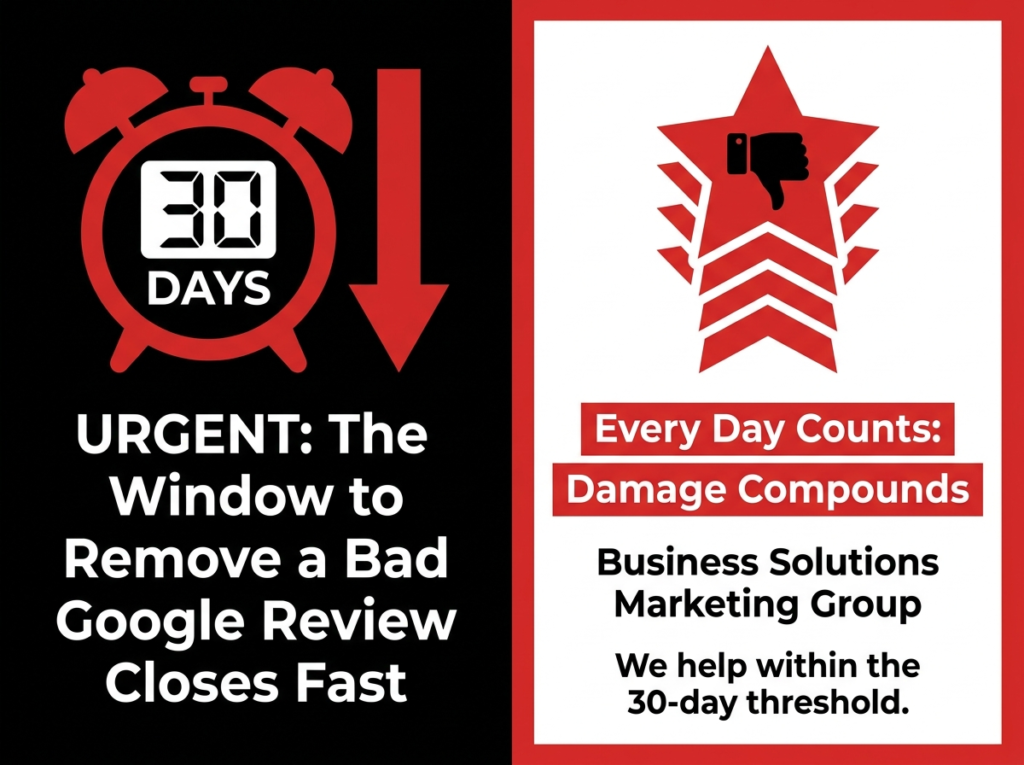
Here is the first thing you need to know: you have a window. And it closes in 30 days.
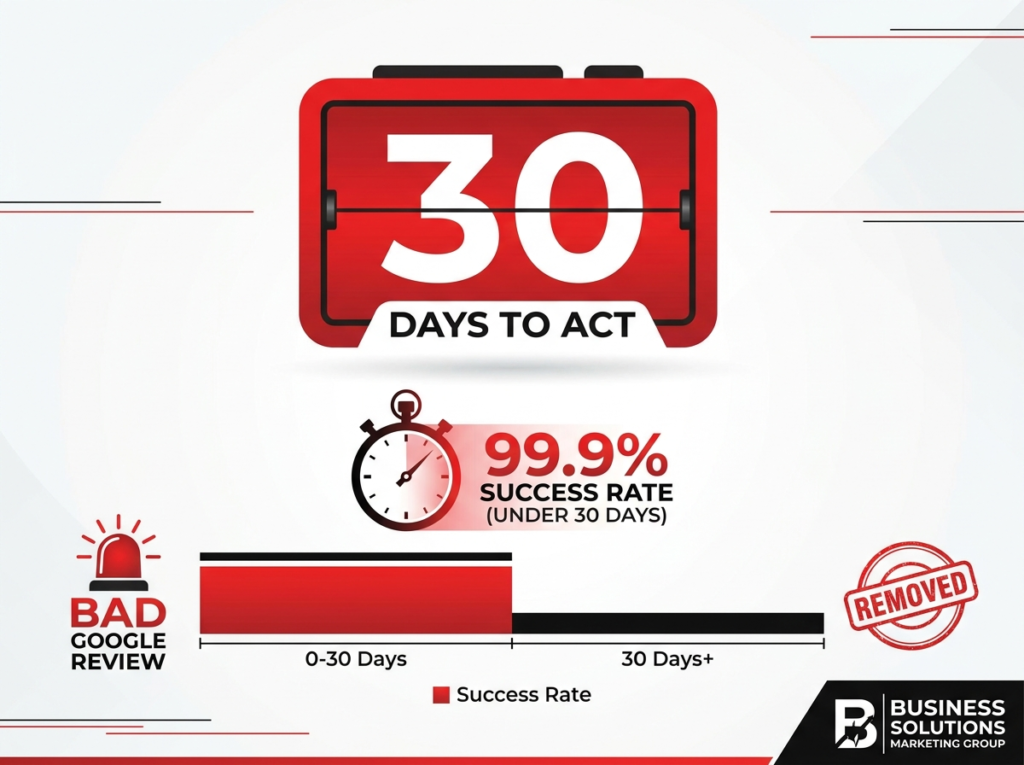
Not forever — but the difference between acting in the first 30 days and waiting longer is enormous. At Business Solutions Marketing Group, our review removal team achieves a 99.9% success rate on reviews that are under 30 days old. That number drops meaningfully once a review ages past that threshold. The reasons are specific, they are documented, and understanding them could save your business real money.
This post is for business owners who just got hit — or who have been sitting on a bad review and wondering if it is too late to do anything. It is also for anyone who wants to understand exactly why timing matters so much in Google review removal, and what the process actually looks like.
Let’s get into it.
KEY TAKEAWAYS
- One bad review causes 94% of consumers to avoid a business — the damage starts the moment it posts (BridgeMedia, 2025)
- Just four negative reviews can cost you 70% of potential clients — four (BridgeMedia, 2025)
- 73% of consumers only trust reviews written in the last 30 days — which means a fresh bad review carries maximum weight (WiserReview, 2026)
- Reviews under 30 days old have a 99.9% removal success rate with our team — after 30 days that rate drops
- Google removed over 240 million policy-violating reviews in 2024 — a 40% increase from 2023 — proving the system works when you know how to use it (ReplyOnTheFly, 2026)
- 10.7% of all Google reviews are estimated to be fake — the highest fake review rate of any major platform (WiserReview, 2026)
- 92% of consumers will only choose a business with a 4-star rating or higher — a bad review pulling you below that threshold is not just reputational damage, it is a revenue problem
- Google’s removal process requires knowing exactly which policy the review violates — guessing wrong wastes precious days
- DIY flagging works sometimes — professional removal works almost always, and within the window
- Our Review Removal Service operates on a no-pay guarantee — you owe us nothing if we do not get the review removed
- Time is the single biggest variable in removal success — if you just got a bad review, the best time to act is right now
Why Does the 30-Day Window Exist?
This is the question I get asked most often, so let me explain it clearly.
When a review is first posted on Google, it is in what you might think of as its most vulnerable state. It is freshly indexed. Google’s systems have not yet deeply embedded it into the business profile’s historical data. The reviewer’s account activity around the time of posting is still recent and traceable. The patterns that indicate a fake, manipulated, or policy-violating review are most visible in the earliest days after it goes up.
Here is what changes over time:
The review gets indexed more deeply. Google’s algorithm begins treating older reviews as more established data points — they become harder to dislodge because the system has more confidence in them. Fresh reviews are inherently more fluid in how they are treated.
The evidence trail gets colder. When we build the case for removal, we look at the reviewer’s profile activity, the timing of the review relative to any business interaction, patterns of reviewing behavior, and cross-platform signals. All of these are sharpest in the first 30 days. After that, account activity changes, patterns shift, and the case becomes harder to document.
The review starts affecting your profile metrics. Once a negative review has been sitting on your profile for weeks or months, it has already influenced your star rating, your Google Maps ranking, and potentially your AI search visibility. Getting it removed still helps — but the downstream damage has already been done to a degree.
Google’s removal system has internal aging. Without getting too technical: Google’s flagging and review process tends to respond faster to recently posted content. The older a review gets, the more manual intervention the removal process requires — and manual processes are slower and less consistent.
This is why we built our service around speed. The moment a bad review posts is the moment the clock starts.
What Does a 99.9% Success Rate Actually Mean?
I want to be transparent about this number because it is important.
Our 99.9% removal success rate applies specifically to reviews that:
- Were posted within the last 30 days
- Violate one or more of Google’s content policies
- Can be documented as policy-violating through our review process
Not every bad review qualifies for removal. Google’s terms are specific. A negative review from a real customer describing a genuinely bad experience — even an unfair one, even an exaggerated one — may not meet the threshold for removal if it does not technically violate policy.
But here is what most business owners do not realize: a significant percentage of bad reviews do violate Google’s policies. They just do not know it. Google removed or blocked more than 240 million policy-violating reviews in 2024 alone — up 40% from the prior year. (ReplyOnTheFly, 2026). That is an enormous number of reviews that should not have been up in the first place.
The types of reviews that are removable under Google’s policies include:
- Fake reviews from people who were never customers
- Competitor reviews posted to damage a rival business
- Conflict of interest reviews — from current or former employees, business owners, or their associates
- Spam or duplicate content — coordinated review attacks, copy-pasted complaints
- Off-topic reviews — reviews that have nothing to do with the actual business experience
- Hate speech, profanity, or personal attacks — content that violates Google’s community guidelines
- Reviews containing false factual claims that can be documented as inaccurate
- Incentivized or compensated reviews that were paid for or exchanged for goods
The challenge is knowing which category applies to the review you are dealing with — and then building the case for removal in a way that Google’s system accepts. That is where expertise makes the difference between a review that stays up indefinitely and one that comes down.
What Happens When Business Owners Try to Remove Reviews Themselves?
The DIY path is the most common first step — and I completely understand why. It feels like the natural thing to do. You flag the review, you submit a report, and you wait.
Here is the reality: Google’s self-service flagging system is inconsistent at best. It works sometimes. It fails a lot. And every failed attempt and every day of waiting is a day that bad review is sitting on your profile doing damage.
According to a 2025 analysis by Search Engine Land, Google is deleting reviews at record levels — but the automated system is blunt instrument. It sometimes removes legitimate reviews (their analysis found that 73.1% of reviews deleted in a recent wave were five-star ratings — real reviews swept up by aggressive AI filtering). (Thrive Agency / Search Engine Land, 2025). And it sometimes leaves up reviews that clearly violate policy because the flagging submission was not framed correctly.
The specific mistakes business owners make when flagging reviews themselves:
- Selecting the wrong policy violation category — Google’s system requires you to identify the exact violation, and choosing the wrong one results in an automatic denial
- Not providing supporting documentation — a bare flag with no context is easy to auto-reject
- Responding emotionally to the review publicly — this actually makes removal harder because it signals engagement with the content
- Waiting too long before acting — each day of inaction is a day of damage and a day closer to the window closing
- Accepting the first denial as final — Google’s initial automated rejections are not the end of the road if you know how to escalate
We have seen business owners spend weeks going back and forth with Google’s support system on a review that we could have resolved in days. In those weeks, the review aged out of the 30-day window and the success probability dropped.
The Real Cost of a Bad Review Sitting on Your Profile
Let me put some numbers on what inaction actually costs.
The immediate customer impact:
- One bad review causes 94% of consumers to reconsider contacting a business. (BridgeMedia, 2025) Not some consumers. Ninety-four percent.
- Just four negative reviews can drive away 70% of potential clients. If you are already sitting on two or three bad reviews and a new one just posted — you may be one more away from losing nearly three quarters of new prospects before they ever contact you.
- 92% of consumers will only choose a business with at least a 4-star rating. A bad review that pulls you below that line does not just hurt you at the margins. It cuts you off from the majority of your potential customers.
- Consumers are willing to pay 22% more for businesses with strong reputations — which means a damaged rating is not just a visibility problem. It is a pricing problem.
The timing multiplier:
Here is the piece that makes the 30-day window so critical: 73% of consumers only trust reviews written in the last 30 days. (WiserReview, 2026). A brand-new bad review carries maximum weight with every potential customer who sees it. It is as current as this morning’s news. Every person who searches for your business in those first 30 days sees that review at the peak of its influence.
Getting it removed in week one is dramatically better than getting it removed in week five — even if the technical outcome (review gone) is the same. The damage accumulates every day it sits there.
The AI search visibility layer:
This is something very few people are talking about yet. Bad reviews are not just hurting your star rating — they are feeding into how AI systems like Google Gemini, ChatGPT, and Perplexity evaluate and recommend your business. AI tools are pulling from your review profile when generating responses to questions like “Who is the best [plumber/accountant/contractor] near me?” A business with a 4.8 rating and 200 reviews gets recommended. One with a 3.9 and a recent batch of bad reviews gets passed over. Cleaning up your review profile is not just about human perception anymore — it is about AI perception too.
What Our Review Removal Process Looks Like
When you contact our team at Business Solutions Marketing Group, here is what actually happens:
Step 1: Immediate assessment We look at the review the same day you contact us. We identify the specific policy violations it contains, assess the reviewer’s profile for additional evidence, and determine which removal pathway gives us the highest probability of success.
Step 2: Case documentation We build the documented removal case — gathering the evidence, framing the policy violation correctly, and preparing the submission in the format that Google’s review team responds to most consistently. This is where the expertise is. It is not just flagging — it is building a case.
Step 3: Submission and escalation We submit through the correct channels and monitor the response. If an initial automated response does not resolve it, we escalate — we know how to do that effectively and within the window.
Step 4: Confirmation and next steps When the review is removed, we confirm it with you. We also talk about what comes next — because removing a bad review is only half the equation. Building a strong, consistent flow of positive reviews is the other half. Our AI Review Builder handles that systematically so your profile stays strong going forward.
Our guarantee: If we take your case and do not remove the review, you pay nothing. We only charge for results.
What to Do Right Now If You Just Got a Bad Review
Here is the action plan — in order:
- Do not respond to the review yet. I know it feels urgent to defend yourself publicly. But responding before you understand whether the review can be removed can complicate the removal process. Hold off.
- Screenshot everything immediately. The review text, the reviewer’s profile, the date and time, any visible details about the reviewer’s other activity. Document it all right now while it is fresh.
- Do not engage with the reviewer privately in a way that could be used to suggest the review reflects a real dispute. Keep everything clean.
- Contact our team immediately. The earlier in the 30-day window you reach out, the higher your removal success probability. Every day counts. You can reach us at businesssolutionsmarketinggroup.com or call (800) 587-0366 — we will assess your review the same day.
- Start building new positive reviews in parallel. Even while removal is in process, a fresh stream of genuine five-star reviews can begin offsetting the rating impact. Our AI Review Builder automates this — asking your happy customers for reviews at exactly the right moment.
- Once the review is removed, respond to your other recent reviews thoughtfully and professionally. This signals active engagement and trust to both humans and AI systems.
A Word About Reviews That Are Older Than 30 Days
If you are reading this and thinking about a review that has been sitting on your profile for months — do not give up. Removal is still possible for older reviews. Our success rate is lower than the 99.9% we achieve in the first 30 days, but it is still meaningful — especially for reviews that contain clear policy violations like fake reviewer profiles, conflict of interest, or documented false claims.
The process is more intensive and takes longer. But it is not hopeless. If you have an older review that is damaging your rating, contact our team for an honest assessment of your specific situation.
The bottom line is this: do not let a bad review age if you can help it. The window is real. The stakes are real. And the solution is available — but only if you act in time.
10 Most Common Questions About Google Review Removal
Q1: How quickly can a Google review actually be removed? It depends on the pathway. Reviews that clearly violate Google’s content policies and are submitted with proper documentation can sometimes come down within 48–72 hours through Google’s review process. Others take 5–10 business days depending on whether escalation is needed. The key variable is whether the submission is framed correctly the first time — a poorly documented flag can trigger an automatic denial that adds days to the process. Our team moves as fast as the process allows, and we prioritize reviews that are still within the 30-day window because the urgency is real.
Q2: What types of Google reviews can actually be removed? Reviews that violate Google’s content policies are eligible for removal. This includes fake reviews from people who were never customers, competitor reviews, conflict of interest reviews (from employees or associates), spam and coordinated attacks, off-topic content, hate speech, profanity, personal attacks, false factual claims, and incentivized or compensated reviews. What is NOT removable under Google’s policies: a genuine negative review from a real customer describing their actual experience, even if it is unfair, exaggerated, or one-sided. The key is identifying which category your review falls into — and that is exactly what our team does in the initial assessment.
Q3: What happens if Google denies my removal request? A denial from Google’s automated system is not final. The initial response to most flagged reviews is automated — meaning a machine evaluated it, not a person. If the automated system denies the request, experienced professionals know how to escalate to a human review team and reframe the case. This is one of the most important reasons to work with professionals rather than navigating the process alone. We have resolved numerous removals that received initial automated denials.
Q4: Will removing a bad review affect my overall star rating? Yes — positively. When a review is removed, Google recalculates your star rating without it. If a 1-star review was pulling your 4.8 average down to 4.3, removing it restores your rating. The recalculation happens relatively quickly after removal — typically within a few hours to a day. This is why bad reviews that drop you below the critical 4-star threshold need to be addressed urgently — 92% of consumers will not choose a business rated below 4 stars.
Q5: Can I remove a review if it is from a real customer who had a bad experience? Not through Google’s removal process — if the review is genuine, describes a real experience, and does not violate any specific policy, it is not removable. What you CAN do: respond professionally and thoroughly (97% of consumers read business responses to reviews), address the specific concern raised, and invite the customer to contact you directly to resolve the issue. Sometimes a well-handled response to a genuine negative review actually builds more trust with future customers than if the review had never existed. And in some cases, resolving the issue leads the reviewer to update or remove their review voluntarily. Our AI Review Builder also helps offset genuine negative reviews by generating consistent new five-star reviews from your satisfied clients.
Q6: How do fake reviews end up on my Google profile? More ways than most people realize. Competitors post them directly. Disgruntled former employees or ex-business partners sometimes organize coordinated negative review campaigns. Bot farms are available for hire and can post multiple reviews from fake accounts quickly. In some cases, a business gets caught in the crossfire — a reviewer leaves a review for the wrong business by mistake. An estimated 10.7% of all Google reviews are fake — the highest fake rate of any major review platform — which means this is not a rare edge case. It is a widespread problem that affects businesses in virtually every industry and market. (WiserReview, 2026)
Q7: What is the difference between flagging a review myself and using a professional removal service? The difference is precision, documentation, and escalation capability. Anyone can flag a review — Google provides a self-service flagging option. But the automated system rejects a high percentage of flags, particularly those that are submitted without proper documentation of the specific policy violation. Professional removal services know how to identify the exact violation, document the case correctly, choose the right submission pathway, and escalate past automated denials when necessary. Our 99.9% success rate for reviews under 30 days versus the inconsistent outcomes of self-service flagging reflects that difference directly.
Q8: Does it cost anything to have a review assessed before I commit to removal? No. Our initial assessment is part of the process. When you contact our team, we review the specific review in question and give you an honest evaluation of whether it is removable, which policy it likely violates, and what the removal process involves. You only pay if we successfully remove the review. There is no upfront fee and no cost if we are unsuccessful. That is our guarantee — and it means we only take cases we believe we can win.
Q9: Can I prevent bad reviews from being posted in the first place? Not entirely — anyone with a Google account can leave a review, and there is no pre-moderation. But you can reduce the volume of negative reviews through proactive reputation management: resolving customer complaints quickly before they become public, asking satisfied customers for reviews immediately after great experiences (which dilutes the impact of any negatives), and monitoring your profile consistently so nothing sits unaddressed. Our AI Review Builder handles the proactive side — systematically generating a steady flow of authentic positive reviews that keep your profile strong and your rating high, making any individual negative review less impactful.
Q10: My bad review is more than 30 days old. Is it still worth trying to remove? Yes — especially if it contains a clear policy violation. The success rate is lower than our 99.9% within-window rate, but meaningful removal is still achievable for older reviews that can be documented as fake, conflicted, or policy-violating. The process is more intensive and results take longer, but it is not a dead end. Contact our team for an honest assessment of your specific review. We will tell you clearly what we think the chances are before you commit to anything. In the meantime, actively building new positive reviews is the most effective parallel strategy — it raises your overall rating and pushes the negative review further down the page. Visit our Review Removal Service page for full details.
ABOUT THE AUTHOR
Linda Donnelly is the founder and owner of Business Solutions Marketing Group, a full-service marketing firm helping small businesses grow for over a decade. Our review removal and reputation management programs have helped hundreds of small businesses protect their Google profiles and grow their star ratings. View all services | Read client testimonials | Contact our team
GBP LInk – https://share.google/C8gU1JB3P6mPKWplN
LinkedIn – https://www.linkedin.com/company/business-solutions-marketing-group-llc/?viewAsMember=true
Instagram – https://www.instagram.com/business_solutions_mg/
Twitter – https://x.com/BSMGLLC
Facebook – https://www.facebook.com/BusinessSolutionsMarketingGroup
BlueSky: https://bsky.app/profile/bussolutions.bsky.social
TikTok – https://www.tiktok.com/@linda_donnelly
YouTube – https://www.youtube.com/channel/UC4w357-txvxOaHff2hTfSSg
