
By Linda Donnelly | Business Solutions Marketing Group
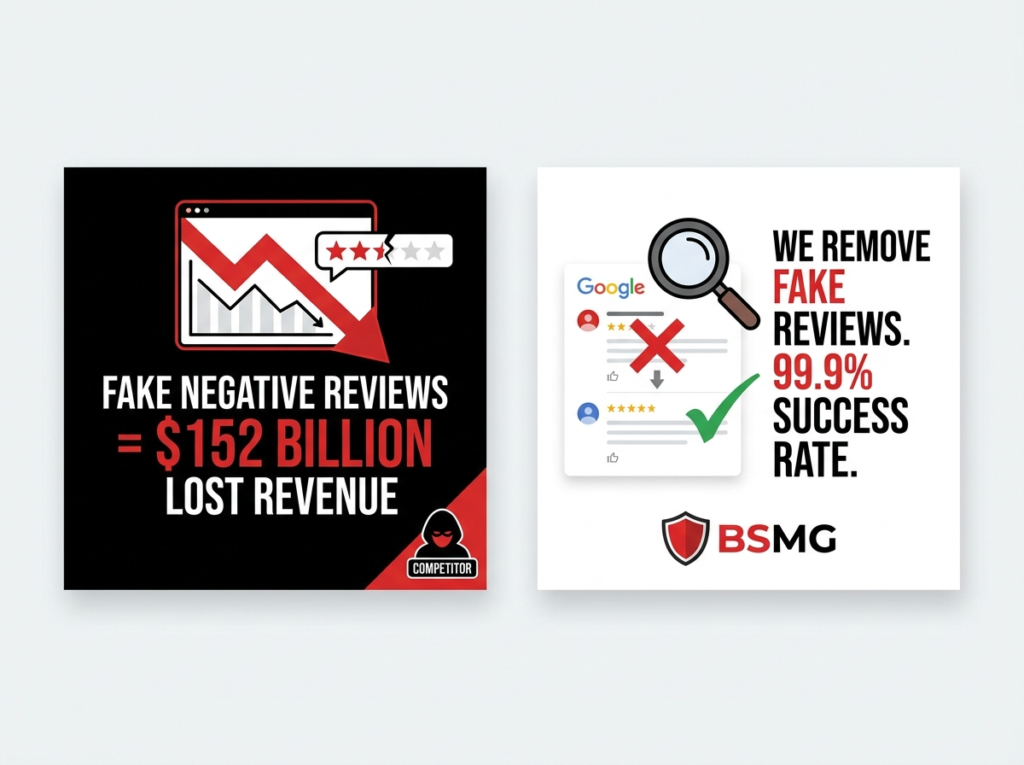
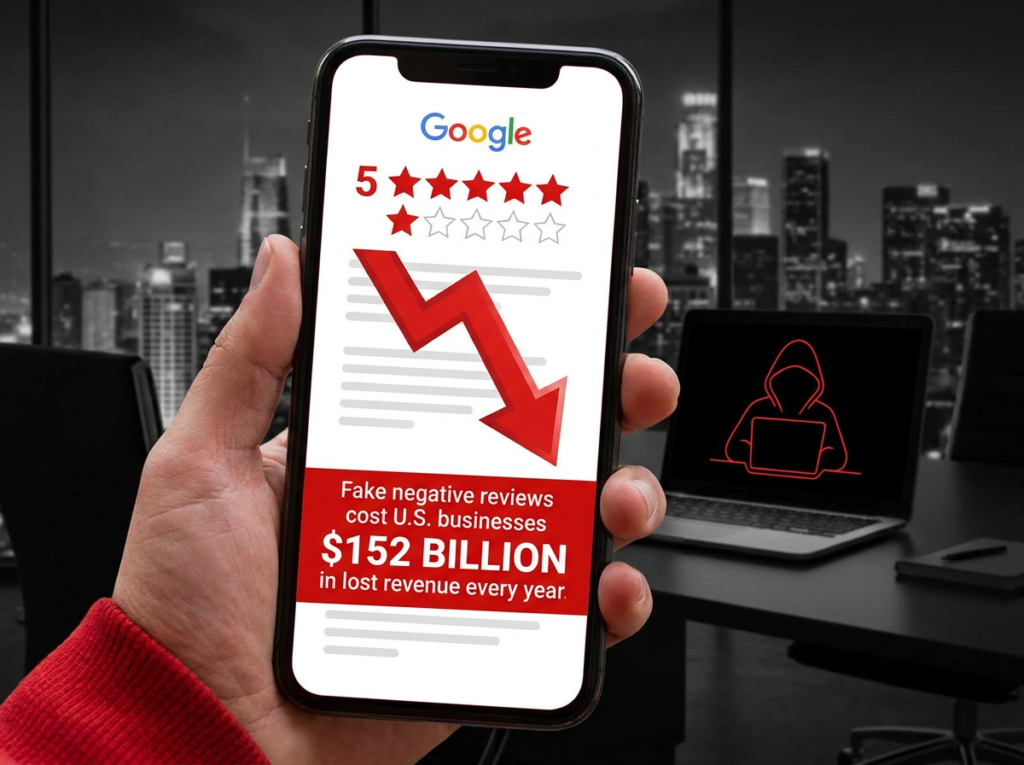
Fake negative reviews are costing U.S. businesses an estimated $152 billion in lost revenue every single year.
Not industry-wide losses from all bad reviews. Just the fake ones. The reviews posted by people who were never your customers, orchestrated by competitors, generated by bots, or purchased from review farms specifically to damage your Google rating and send your potential clients elsewhere.
It is not paranoia. It is one of the fastest-growing forms of business sabotage in America — and it is happening in virtually every competitive local market.
I have been helping small businesses with their marketing for over a decade at Business Solutions Marketing Group. In that time, I have watched fake review attacks go from a fringe concern to a mainstream threat. I have seen businesses drop from 4.8 stars to 3.1 in a matter of weeks because a competitor deployed a bot farm. I have seen one-star reviews posted by reviewer accounts created the same day — clearly fake, clearly malicious, and sitting on a Google profile doing real damage while the business owner had no idea what to do about them.
If that sounds like your situation right now, this post is for you. I am going to walk you through exactly what fake reviews look like, what qualifies for removal under Google’s policies, why the timing of your response matters enormously, and what the difference is between handling this yourself and having professionals do it for you.
Let’s start with the scope of the problem — because it is bigger than most people realize.
KEY TAKEAWAYS
- Fake negative reviews reduce business revenue by 25% on average — and cost U.S. businesses an estimated $152 billion annually (WiserReview, 2026)
- 10.7% of all Google reviews are estimated to be fake — the highest fake review rate of any major platform (WiserReview, 2026)
- 80% of all consumers encounter a fake review annually — among 18–34-year-olds, that figure jumps to 92% (Nadernejad Media, 2026)
- A 2024 study found 18% of Google reviews for small and medium businesses show signs of potential fraud — up from 12% in 2022 (Trustpiple, 2024)
- Google removed 240 million policy-violating reviews in 2024 — a 40% increase from 2023 — proving the removal system works when used correctly (WiserReview, 2026)
- The FTC’s Consumer Review Fairness Rule now makes fake reviews punishable by fines of up to $53,088 per violation — each individual fake review counts separately (Reply Champion, 2026)
- Reviews under 30 days old have a 99.9% professional removal success rate — waiting costs you far more than just time
- DIY flagging is inconsistent and frequently rejected — professional removal knows which policy was violated, how to document the case, and how to escalate past automated denials
- Our Review Removal Service operates on a no-pay guarantee — you owe us nothing if the review is not removed
- A California bakery won $50,000 in damages from a competitor who orchestrated a fake review campaign — legal recourse is real and growing (Trustpiple, 2024)
- Removing fake reviews and consistently building real ones is a two-part strategy — our AI Review Builder handles the second half automatically
The Fake Review Economy Is Bigger Than Most Business Owners Know
Here is a number I want you to sit with: $152 billion. That is how much fake negative reviews cost U.S. businesses in lost revenue annually — not all bad reviews, not all competition, just the fraudulent ones designed to damage honest competitors. (WiserReview, 2026)
The fake review industry has evolved into a sophisticated, two-sided economy. On one side, businesses buy fake five-star reviews to inflate their own ratings. On the other — and this is the one that should concern you — businesses buy fake one-star reviews to sabotage competitors. Both are illegal under the FTC’s updated Consumer Review Fairness Rule. Both happen constantly. And because the tactics have become more sophisticated, they are harder for the average business owner to recognize and respond to.
Consider the scale:
- 10.7% of all Google reviews are estimated to be fake — the highest fake review rate of any major platform, higher than Yelp at 7.1% and TripAdvisor at 5.2% (WiserReview, 2026)
- 18% of Google reviews for small and medium businesses showed signs of potential fraud in a 2024 study — up from 12% just two years earlier (Trustpiple, 2024)
- 80% of consumers encounter fake reviews annually — and 92% of those aged 18–34 report identifying deceptive review practices (Nadernejad Media, 2026)
- Google has deployed its Gemini AI system into review moderation — but it is an imperfect tool that sometimes removes real reviews while leaving fraudulent ones in place
The tactics being used are not primitive anymore. We are seeing coordinated multi-account attacks where dozens of fake negative reviews hit a profile within hours. We are seeing bot farms generate reviewer accounts that look convincingly real. We are even seeing a disturbing new tactic where competitors buy fake five-star reviews for their rivals — specifically to trigger Google’s fraud detection and get the competitor’s profile penalized.
This is not a problem that resolves itself. It requires deliberate, informed action.
How to Recognize a Fake Google Review on Your Profile
Not every bad review is a fake one. Real customers have bad experiences, and their feedback — even when it stings — is legitimate. The first step in fighting back is making sure you can identify what you are actually dealing with.
Signals that a review is likely fake:
- The reviewer has no review history or created their account very recently — often the same week or day the review was posted
- The reviewer has only one review — ever — and it is the one-star hit on your profile
- The review is vague with no specific details — no mention of staff names, specific services, dates, or experiences that a real customer would know
- Multiple similar reviews posted in a short window — especially if the language is similar across them or they all lack verifiable details
- The reviewer has no profile photo, no location, and no other activity on Google
- The complaint has nothing to do with your actual services — off-topic reviews that describe experiences your business does not provide
- A wave of bad reviews followed a competitive event — a new competitor opening nearby, a pricing dispute with a former vendor, or a negative interaction with a known individual
- The review appears to be from a current or former employee — recognizable by specific internal details or personal grudges that no customer would know
- The language is identical to or very similar to a review left for another business — coordinated review farms often reuse templates
The 2024 study by the Online Reputation Institute found that nearly 1 in 5 reviews for small businesses showed fraud indicators. If you are seeing multiple flags from the list above, trust your instincts. You are probably right.
What Google’s Policies Actually Allow You to Remove
This is where a lot of business owners run into trouble. They assume that because a review is clearly fake or unfair, it automatically qualifies for removal. Google’s process does not work that way. Removal requires identifying the specific policy violation — and submitting the case in a way that makes that violation clear.
Here is what Google’s content policies allow for removal:
- Fake reviews and spam — reviews from accounts that show no real customer relationship with the business, coordinated review campaigns, or reviews that appear generated by bots
- Conflict of interest reviews — reviews from current or former employees, business owners, their family members, or competitors
- Off-topic content — reviews that do not describe a genuine customer experience with the business
- Hate speech, profanity, and personal attacks — content that violates Google’s community standards
- Privacy violations — reviews that include personal information or make specific false factual claims about identifiable individuals
- Incentivized or compensated reviews — reviews that were exchanged for money, free services, or other goods
- Reviews from someone who has never been a customer — including reviews posted by mistake on the wrong business
What does NOT qualify for removal:
A genuine negative review from a real customer, even if it is harsh, unfair, exaggerated, or one-sided. As long as the reviewer was an actual customer and the review does not violate a specific policy, Google will not remove it. This is a hard line that even professional removal services cannot cross — and any service that claims otherwise is not being honest with you.
The challenge is that many fake reviews are designed to look like real ones. They use plausible language, avoid obvious policy violations, and are posted by accounts that appear semi-legitimate. Identifying the specific policy hook that makes removal possible requires knowledge of Google’s policies and experience with how the review moderation system operates.
Why DIY Flagging So Often Fails — and What Professionals Do Differently
The first thing most business owners do when they spot a fake review is flag it using Google’s self-service tool. I understand why — it is the obvious first step and it is right there in your Google Business Profile dashboard. But here is the honest truth about how that usually goes.
The DIY flagging problem:
Google’s self-service flagging is handled primarily by automated systems. Those systems are processing an enormous volume of flags — Google removed 240 million policy-violating reviews in 2024 alone — and the automated triage tends to reject submissions that are not framed precisely. A flag submitted without identifying the specific policy violation clearly, without supporting documentation, or through the wrong submission pathway often gets an automated denial within 24–48 hours.
Many business owners see that denial and conclude the review cannot be removed. That is almost never true. The denial usually means the submission was not handled correctly — not that the review is legally protected.
What professional removal does differently:
- Identifies the exact policy violation — not just “this seems fake” but the specific Google content policy the review violates, cited precisely
- Documents the case — reviewer account history, timing patterns, cross-platform signals, any evidence of a business relationship (or lack thereof)
- Chooses the correct submission pathway — different violations are handled through different Google channels, and using the wrong one wastes days
- Escalates past automated denials — experienced professionals know how to move a case from automated triage to human review when the initial response is a rejection
- Acts within the critical 30-day window — reviews under 30 days old have the highest removal success rate; professional teams move fast enough to stay inside that window
Our team at Business Solutions Marketing Group achieves a 99.9% success rate on fake reviews that are under 30 days old. That number is not possible with a basic self-service flag. It comes from knowing exactly how Google’s policies and removal process work — and using that knowledge precisely.
The 30-Day Window — Why Speed Is Everything With Fake Reviews
I covered this in detail in our blog post on the 30-day review removal window, but it bears repeating here because it is the single most important variable in fake review removal.
When a review is freshly posted:
- Google’s systems have not yet deeply indexed it as established profile data
- The reviewer’s account activity around the time of posting is most traceable
- The patterns that indicate a fake or policy-violating review are most visible
- The case for removal can be built with the sharpest, most current evidence
After 30 days, each of these factors shifts. Removal is still possible — but the success rate drops, the process takes longer, and the evidence gets harder to document with precision.
What this means for fake review attacks:
If a competitor hits your profile with a coordinated fake review campaign, the single most important thing you can do is move immediately. Not after a few days of hoping it resolves itself. Not after waiting to see if Google’s automated systems catch it. The moment you recognize what is happening — contact professionals and begin the removal process.
Every day that fake review sits on your profile, it is doing measurable damage:
- 73% of consumers only trust reviews from the last 30 days — a fresh fake review carries maximum weight with every potential customer who sees it
- Fake negatives reduce business revenue by 25% on average — and that damage compounds daily
- A coordinated attack of even three or four fake one-star reviews can pull a 4.8 rating below 4.0 — the critical threshold below which 92% of consumers will not choose a business
The faster you act, the better your outcome. Our Review Removal Service is built around this urgency. We assess every case the same day, begin the removal process immediately, and prioritize reviews that are still within the window.
The Legal Landscape Around Fake Reviews Is Getting Serious
This is something very few small business owners are aware of yet — but it matters for two reasons. First, it gives you legal options beyond Google’s removal process. Second, it means the businesses deploying fake reviews against you are taking on real legal exposure.
The FTC’s Consumer Review Fairness Rule (effective October 2024) now makes fake reviews a federal enforcement matter. Each individual fake review counts as a separate violation, with fines of up to $53,088 per violation. A competitor who deploys 50 fake reviews against you could theoretically face $2.6 million in FTC penalties. (Reply Champion, 2026)
The FTC issued its first enforcement warning letters in December 2025, signaling that enforcement is no longer theoretical. And the legal precedents are being established in civil court as well. A California bakery won $50,000 in damages from a competitor who orchestrated a fake review campaign against them. (Trustpiple, 2024) That case set a civil litigation precedent that other businesses are now referencing.
If you have documentation of a competitor-orchestrated fake review attack — timestamps, reviewer account patterns, evidence of coordination — you may have grounds for legal action that goes beyond simply asking Google to remove the reviews. Our team can help you understand what documentation to preserve and when it makes sense to involve a legal professional.
What to Do Right Now If You Are Under a Fake Review Attack
Here is the action plan — move through these steps in order:
- Document everything immediately. Screenshot every suspicious review, every reviewer profile, the timestamps, and any patterns you notice. Do this before anything changes or before reviews are removed. Documentation is everything.
- Cross-check the reviewer profiles. Look at each suspicious reviewer’s Google account. When was it created? How many reviews have they left? Do they have any other Google activity? A reviewer account created yesterday with one review — yours — is a major red flag.
- Do not respond emotionally. I know it is tempting to call out the fake reviews publicly or defend yourself aggressively. Resist it. A professional, measured response is appropriate — but only after you understand whether removal is possible. An emotional public response can complicate the removal process.
- Contact our team immediately. The earlier you reach out, the higher your probability of full removal. We assess every case the same day. Business Solutions Marketing Group — call (800) 587-0366 or request a review assessment at our Review Removal Service page.
- Start generating new authentic reviews in parallel. Even while removal is in process, a steady flow of genuine five-star reviews begins offsetting the rating damage. Our AI Review Builder automates this — asking your happy customers for reviews at exactly the right moment. You cannot rely on removal alone. You need both defense and offense.
- Preserve evidence for potential legal action. If the attack is clearly coordinated and you have documentation, preserve everything in case a legal response is warranted. The FTC’s recent enforcement activity makes this more relevant than it has ever been.
10 Most Common Questions About Fake Google Review Removal
Q1: How do I know if a Google review is actually fake? The clearest signals are: the reviewer account was created very recently, the reviewer has only one review (yours), the complaint is vague with no specific details a real customer would know, multiple similar reviews appeared within a short window, or the review describes services or experiences that do not match what your business actually does. A 2024 study found that 18% of Google reviews for small businesses showed fraud indicators — so you are not being paranoid. If something feels off, it probably is. Document what you find and contact our team for a same-day assessment. Our Review Removal Service evaluates every case at no charge before you commit to anything.
Q2: Can Google actually remove a fake review, or does it just stay up forever? Google absolutely can and does remove policy-violating reviews. In 2024 alone, Google removed 240 million policy-violating reviews — a 40% increase from the prior year. The system works. The challenge is that Google’s automated triage is inconsistent, and DIY flagging frequently results in automated rejections that are not actually final decisions. Professional removal services know how to build the case correctly, submit through the right pathway, and escalate past automated denials. Our 99.9% success rate on reviews under 30 days is evidence of what is possible when the process is handled correctly.
Q3: Can a competitor really get away with posting fake reviews about my business? Less and less. The FTC’s Consumer Review Fairness Rule, effective October 2024, makes each fake review a separate violation with fines up to $53,088. Google’s Gemini AI is increasingly sophisticated at detecting coordinated attacks. And civil litigation precedents are being established — a California bakery won $50,000 from a competitor who ran a fake review campaign against them. The legal and financial risk for competitors deploying fake reviews has never been higher. That said, enforcement after the fact is cold comfort when reviews are actively damaging your business right now. Removal is the immediate priority. Legal recourse can be pursued in parallel if the evidence supports it.
Q4: What happens if Google denies my removal request? An automated denial from Google is not a final decision. It means the automated system evaluated your submission and determined it did not meet the threshold it was looking for — which is almost always a documentation or framing issue, not a determination that the review is legitimate. Experienced professionals know how to escalate past the automated system to a human review team, reframe the case with better documentation, and navigate the escalation pathways that most users do not know exist. We handle escalations as a standard part of our removal process.
Q5: How quickly can a fake review be removed? With proper documentation and submission, clearly policy-violating reviews can sometimes come down within 48–72 hours. Others require escalation and take 5–10 business days. The single most important factor is acting within the 30-day window — reviews under 30 days old have the highest removal success rates. Every day of delay is a day of damage and a day closer to the window closing. Contact our team the same day you identify the problem.
Q6: What if the fake reviews are clearly from a competitor but I cannot prove it definitively? You do not always need definitive proof of who is behind the reviews to get them removed. What matters is demonstrating that the reviews violate Google’s content policies — through reviewer account analysis, timing patterns, and the absence of any documented customer relationship. Identifying who orchestrated the attack is relevant to potential legal action but is not a prerequisite for Google removal. Our team focuses on the policy violation, not necessarily the identity of the perpetrator, when building the removal case.
Q7: Can I sue someone for leaving a fake Google review about my business? Yes — and the legal landscape is increasingly favorable for businesses doing so. Civil defamation claims are available when a review contains false statements of fact. The FTC’s 2024 rule creates federal enforcement exposure for orchestrated fake review campaigns. And the California precedent of a $50,000 civil judgment against a competitor for a fake review campaign shows that courts are taking this seriously. Pursuing legal action requires evidence, documentation, and an attorney. Our role is to remove the reviews quickly through Google — but we can advise you on what documentation to preserve for potential legal action.
Q8: Will my star rating recover after fake reviews are removed? Yes — Google recalculates your star rating automatically when reviews are removed. If three fake one-star reviews were pulling your 4.7 average down to 3.9, their removal restores your rating. The recalculation typically happens within hours to a day after removal. Combined with our AI Review Builder — which generates a consistent stream of authentic five-star reviews from real clients — you can recover and strengthen your rating faster than you might expect.
Q9: Is it worth trying to remove older fake reviews that have been up for months? Yes — especially if they contain clear policy violations. Our success rate is lower than the 99.9% we achieve within 30 days, but meaningful removal is still possible for older reviews that can be documented as fake, coordinated, or policy-violating. The process is more intensive and results take longer, but it is not hopeless. Contact our team for an honest assessment of your specific situation — we will tell you clearly what we think before you commit to anything.
Q10: What can I do to prevent fake review attacks in the future? You cannot completely prevent them — anyone with a Google account can leave a review, and determined bad actors will find ways to post. But you can reduce their impact significantly through three practices. First, build a large enough volume of authentic reviews that individual fakes carry less weight — our AI Review Builder handles this systematically. Second, monitor your Google Business Profile consistently so you catch attacks quickly and act within the 30-day window. Third, respond professionally to every review so potential customers see active engagement. A business with 200 genuine reviews and a 4.8 average is far more resilient to a fake review attack than one with 15 reviews and a 4.2 average. Volume and velocity are your best long-term defense.
ABOUT THE AUTHOR
Linda Donnelly is the founder and owner of Business Solutions Marketing Group, a full-service marketing firm helping small businesses grow and protect their online reputation for over a decade. Our review removal and reputation management programs have helped hundreds of small businesses fight back against fake reviews and rebuild their Google profiles. View all services | Client testimonials | Get a free review assessment
GBP LInk – https://share.google/C8gU1JB3P6mPKWplN
LinkedIn – https://www.linkedin.com/company/business-solutions-marketing-group-llc/?viewAsMember=true
Instagram – https://www.instagram.com/business_solutions_mg/
Twitter – https://x.com/BSMGLLC
Facebook – https://www.facebook.com/BusinessSolutionsMarketingGroup
BlueSky: https://bsky.app/profile/bussolutions.bsky.social
TikTok – https://www.tiktok.com/@linda_donnelly
YouTube – https://www.youtube.com/channel/UC4w357-txvxOaHff2hTfSSg
