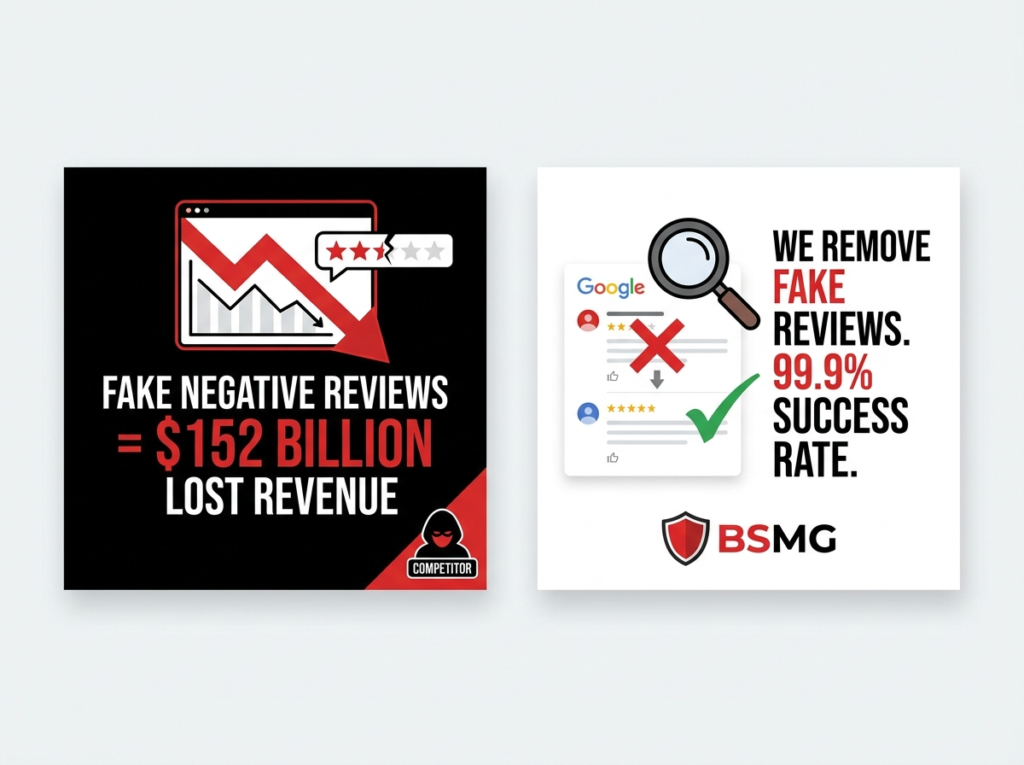
A staggering $152 billion. That is exactly how much global consumer spending is influenced by fake online reviews every single year, according to a comprehensive study by the World Economic Forum.
It gets worse! The Federal Trade Commission (FTC) is currently cracking down on deceptive online practices with an iron fist. Civil penalties for violating the FTC’s Consumer Review Rule now carry a crushing fine of up to $53,088 per violation, as detailed on the FTC’s official enforcement page.
If you are reading this while staring at a string of mysterious one-star reviews on your Google Business Profile, I know exactly how you feel. Your stomach drops. You feel a massive sense of injustice. I am Linda Donnelly, owner of Business Solutions Marketing Group. For over a decade, I have helped small business owners protect their brands and grow their revenues. I see this exact scenario play out every week. A business owner works relentlessly for years to build a five-star reputation, only for a jealous competitor to launch a cowardly, anonymous attack.
When you are in the middle of a competitor attack, it feels personal. It feels completely overwhelming. But do not panic! You are not helpless, and you certainly do not have to accept this as the cost of doing business.
Let’s break down exactly how these attacks happen, how we catch them, and how you can fight back.
The Devastating Impact of a Single Fake Review
Let’s address the elephant in the room. Can one or two fake reviews really do that much damage? Absolutely.
Consumers are remarkably protective of their money. Research from BrightLocal shows that 76% of consumers regularly read online reviews when browsing for local businesses. A sudden drop in your overall star rating doesn’t just bruise your ego. It immediately redirects high-intent buyers straight into the arms of the very competitor who attacked you!
Google’s algorithm also factors in review velocity and sentiment when deciding where to rank you in the Local Pack. If a competitor hits you with a barrage of negative ratings, your visibility tanks.
How We Spot Competitor Sabotage
You cannot just tell Google, “I think my competitor wrote this.” You need hard proof. When we analyze a profile for a client, we act like digital detectives. Here is exactly how you identify competitor-sourced fake reviews:
- Account History and Activity: This is the biggest giveaway. Fake accounts usually have zero other review history. Or, conversely, they have a bizarre cluster of reviews. For example, they might leave a scathing one-star review on your profile, and on the exact same day, leave a glowing five-star review for a business right down the street.
- Timing Patterns (The “Review Bomb”): Real customer feedback trickles in naturally over time. Competitor attacks often happen in coordinated bursts. Did you just launch a massive marketing campaign? Did you just outrank them for a major keyword? A sudden spike of three or four negative reviews over a weekend is a massive red flag.
- Language and Context Analysis: Pay close attention to the wording. Fake reviews often use specific industry terminology that a normal customer would never use. Even better (for our case), they sometimes explicitly name-drop the competitor! They will say something like, “Terrible service here, do not waste your money. Go to XYZ Plumbing instead, they are much better.” ## Building the Ultimate “Conflict of Interest” Case
Successful competitor fake Google review removal requires you to speak Google’s language. Google has a very specific policy called “Conflict of Interest.” It explicitly states that reviewing a competitor’s business to manipulate their ratings is a strict violation.
Hitting the “flag” button on your dashboard is rarely enough. The automated bot will likely reject a basic flag. You need to build a documented case for a human reviewer.
- Cross-Reference Your CRM: Export the reviewer’s name and run it through your customer database. Take a screenshot proving that no one by that name has ever booked a service, bought a product, or interacted with your company.
- Gather IP and Location Clues: Look at the reviewer’s profile. Are they located in a completely different state? Take screenshots of their other reviews to establish a geographic discrepancy.
- Connect the Dots: Do some LinkedIn and Facebook sleuthing. You would be shocked at how often a “random” reviewer is actually an employee, spouse, or vendor of a direct competitor. Screenshot these connections!
- Draft the Appeal: When you submit your appeal through the Google Review Management tool, be clinical. State the exact policy violation (Conflict of Interest). Attach your screenshots. Explain that this is a coordinated attack by a competing entity.
When to Bring in the Heavy Artillery
Building a bulletproof case takes time, energy, and a deep understanding of Google’s internal escalation pathways. When you are trying to run a business, spending hours hunting down digital footprints is a massive drain on your resources.
Furthermore, if your initial appeal gets denied by Google, the path forward gets incredibly complicated.
This is where my team steps in. We do not mess around with automated bots. We bypass the standard channels and escalate directly to human teams, using legal frameworks and undeniable evidence to force the removal of malicious content. If you are exhausted by this fight, let us handle it. You can learn exactly how we permanently delete these attacks by checking out our remove negative Google Reviews Here – https://businesssolutionsmarketinggroup.com/services/review-removal-service/. We legally and safely restore your hard-earned rating so you can get back to what you do best: running your business.
Key Takeaways
- Financial Threat: Fake reviews influence $152 billion in spending annually. This is a severe threat to your bottom line.
- Heavy Fines: The FTC is levying fines of up to $53,088 per violation for fake consumer reviews.
- Look for Patterns: Identify attacks by looking for blank account histories, coordinated timing spikes, and unnatural language.
- Cite the Policy: When escalating to Google, explicitly state that the review violates their “Conflict of Interest” guidelines.
- Document Everything: Screenshots of CRM searches, LinkedIn profiles, and competitor connections are your best weapons.
10 Frequently Asked Questions
1. How long does competitor fake Google review removal take?
If the automated system removes it after a flag, it takes 3 to 7 days. If you have to build a formal appeal and escalate it manually, it can take anywhere from a few weeks to over a month.
2. Will Google tell my competitor that I reported them?
No. The reporting and escalation process is entirely confidential. The user who left the review will not receive a notification that you are actively trying to take it down.
3. Can I sue a competitor for a fake review?
Yes, but it is complicated. If you can definitively prove their identity and demonstrate actual financial damages, you can sue for defamation or tortious interference. However, litigation is incredibly expensive. Removal is usually the faster, cheaper route.
4. What if the competitor used a fake name?
This is very common. We combat this by documenting that the “person” does not exist in your CRM and highlighting behavioral patterns on their Google account that point to spam or conflict of interest.
5. Should I reply to a review I know is fake?
Absolutely! Reply professionally. Say, “We have looked into our records and have no customer matching this name or details. We take customer service seriously; please contact our office immediately.” This shows future customers you are responsive while you work behind the scenes to delete it.
6. Does Google check IP addresses for fake reviews?
Google’s automated systems do track IP addresses and device IDs to look for bot networks. However, they do not share this data with business owners for privacy reasons.
7. Can I just turn off reviews on my Google profile?
No. Google does not allow businesses to disable reviews. The only way to stop the damage is to actively manage and remove policy-violating content.
8. What is a “Review Bomb”?
A review bomb is a coordinated effort where a business receives a massive influx of negative reviews in a very short period. This is often triggered by a competitor or an angry online mob. Google has systems to pause reviews when they detect a bomb.
9. Can an ex-employee leave a bad review?
No. This is a direct violation of Google’s Conflict of Interest policy. If you can prove the reviewer is a former employee, Google will take it down.
10. Do I have to pay a monthly retainer for review removal?
No! Any reputable agency will only charge for the successful removal of the specific malicious reviews. Avoid companies that require you to pay a monthly fee for “monitoring” just to remove a single fake review.