By Linda Donnelly | Business Solutions Marketing Group
Nearly 60% of Google searches now end without a single click. No one visits your website. No one sees your content. They get their answer directly from the search results page — and they move on. If that stat doesn’t make you sit up a little straighter, read it again.
That’s not a glitch. That’s the new reality of search. And if your marketing strategy is still purely built around traditional SEO, you’re operating in a world that is rapidly changing underneath you.
I’ve been helping small businesses with marketing for over a decade at Business Solutions Marketing Group. I’ve watched SEO evolve from keyword stuffing to content strategy to technical optimization. But I’ve never seen a shift quite this significant. The rise of AI-powered search — and the two emerging disciplines that go with it, Answer Engine Optimization (AEO) and Generative Engine Optimization (GEO) — is not hype. It’s a fundamental rewiring of how your customers find you.
The good news? You don’t have to scrap everything you know. You just have to expand your playbook.
Let’s break it all down.
First, Let’s Get Clear on What Each One Actually Is
Before we can talk about strategy, you need to understand what we’re dealing with. These three disciplines are related — but they are not the same thing.
Traditional SEO: The Foundation You Already Know
SEO, or Search Engine Optimization, is the practice of optimizing your website and content so that Google (and other search engines) rank you higher in their results pages. This means using the right keywords, building quality backlinks, creating valuable content, and making sure your website is technically sound — fast, mobile-friendly, and easy to crawl.
Here’s the thing about SEO: it’s not dead. Not even close. According to BrightEdge, 68% of all online experiences still begin with a search engine. Traditional SEO generated 1,000% more traffic than social media in 2024. That’s not a tactic you abandon.
Our Local SEO & Google Maps Dominance services are built around exactly this foundation — helping small businesses own their local search presence before layering in what comes next.
But SEO was built for a world where users typed a query, got a list of blue links, and clicked one. That world is still very much alive — but it now shares space with something much newer.
AEO: Answer Engine Optimization
AEO is about getting your content selected as the answer when someone asks a question — whether to Google’s AI Overviews, Siri, Alexa, ChatGPT, or any other AI-driven search tool. Instead of optimizing to rank on page one, you’re optimizing to be the direct response.
Think about this: when someone asks their phone “What’s the best way to market a small business on a tight budget?” — they’re not looking for a list of websites to dig through. They want the answer. AEO is how you make sure your business provides it.
Over 50% of searches are now zero-click, meaning users get answers directly from featured snippets — which is exactly the goal of AEO. And voice search is accelerating this hard. By 2024, voice searches were expected to make up 50% of all queries. Those searches don’t produce a ranked list. They produce one answer. Yours, or someone else’s.
This is exactly why we built Answer Engine Optimization into our Three Pillars of AI Dominance framework — it’s not optional anymore for businesses that want to stay visible.
GEO: Generative Engine Optimization
GEO is the newest of the three. It’s the practice of optimizing your content so that large language models — tools like ChatGPT, Google Gemini, and Perplexity — actually cite you when generating their responses.
This is subtle but important. When someone asks ChatGPT “Who are some trusted marketing consultants for small businesses?” — ChatGPT doesn’t search Google. It synthesizes information from its training data and live web access to generate an answer. GEO is how you earn a seat at that table.
The data on this is staggering. According to a June 2025 analysis by WebFX and SimilarWeb, AI platforms generated 1.13 billion referral visits in June 2025 alone — a 357% increase year over year. And AI-referred traffic converts at a 14.2% rate, compared to 2.8% from Google. Read that again. Traffic coming from AI search is five times more likely to convert.
This matters enormously for small businesses. The U.S. GEO market is expected to reach $365.4 million in 2026, with a compound annual growth rate of 42.9%. (Omnibound GEO Statistics, 2026). The businesses building GEO into their strategies right now are getting ahead — fast.
Where SEO, AEO, and GEO Overlap
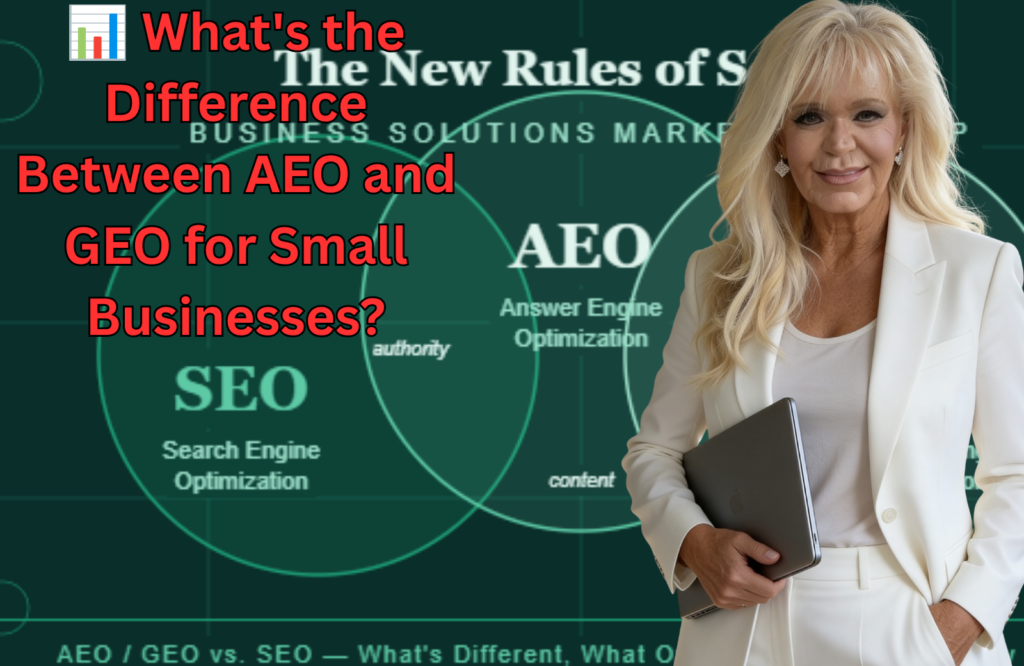
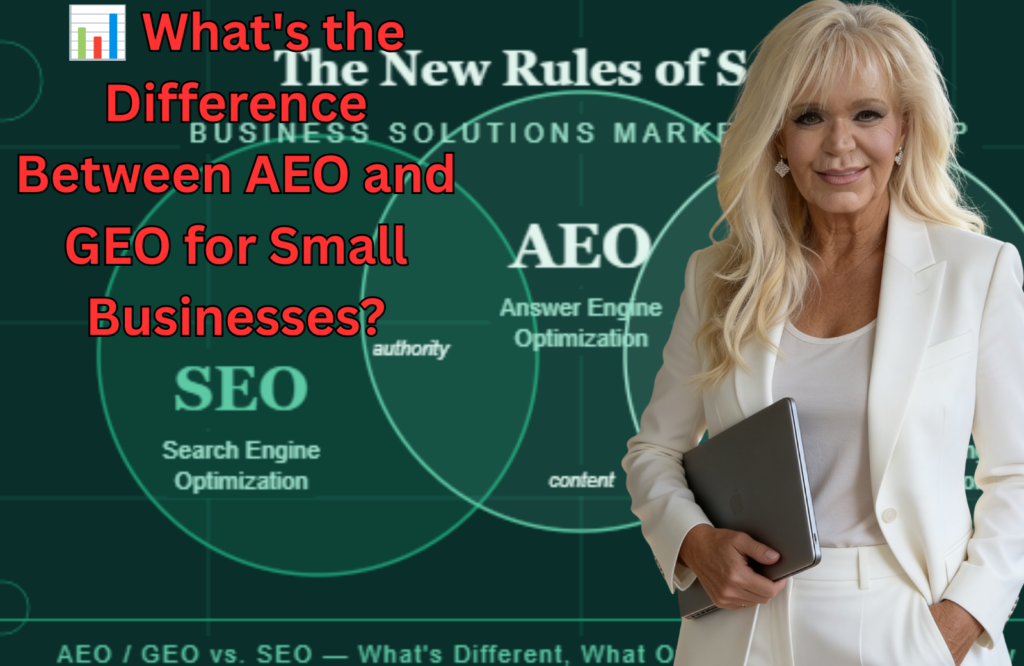
Here’s the part a lot of people miss: these three strategies share a strong common foundation. You don’t build three separate content silos. You build one great content strategy that’s optimized intelligently for all three.
What do they all have in common?
- High-quality, authoritative content. Google’s algorithm rewards it. AI models cite it. Voice search surfaces it. This is non-negotiable across all three disciplines. Our Blog Writing service is designed specifically to produce this kind of content — structured to rank, answer, and get cited.
- E-E-A-T: Experience, Expertise, Authoritativeness, Trustworthiness. This Google framework originally powered SEO. It now drives GEO rankings too. Content with transparent author bios, reputable citations, and consistent updates regularly outperforms shallow material.
- Schema markup. Adding structured data to your website helps search engines and AI models understand exactly what your content is about — whether it’s an FAQ, a review, a service offering, or an event. Our Web Development team builds this in from the ground up.
- Site speed and mobile performance. Still critical for SEO. Also critical for how AI models assess site quality. Run a free local SEO scan to see where your site currently stands.
- Backlinks and brand authority. According to research from Pixelmojo citing the Princeton GEO paper and Semrush’s 2025 data, brand search volume has the highest correlation (0.334) with AI citations — stronger than any on-page optimization technique. If people search for your brand by name on Google, AI platforms are more likely to cite you. Your SEO brand-building directly feeds your GEO visibility.
- Online reviews and reputation signals. AI systems pull heavily from third-party trust signals. Your Google reviews, your star rating, your reputation across directories — all of it feeds into how AI perceives and presents your business. This is exactly why Reputation Rescue and Review Removal are core parts of an AI-ready marketing strategy.
The overlap is significant. A business investing seriously in quality SEO is already building the foundation for AEO and GEO success. The additional work isn’t starting over — it’s extending what you’re already doing.
What’s Actually Different — and Why It Matters
Now for the distinctions that will change how you approach your content.
SEO Is About Ranking. AEO and GEO Are About Being Cited.
Traditional SEO asks: How do I rank higher on the results page? AEO asks: How do I become the answer? GEO asks: How do I get cited by AI when it generates responses?
These are different goals requiring different tactics. Here’s what that looks like in practice:
For AEO — optimize to be the answer:
- Structure your content to directly answer specific questions
- Use FAQ schema markup so search engines can surface your answers as featured snippets
- Write in clear, concise language that AI assistants can easily extract and read aloud
- Target conversational, long-tail question keywords (“how do I,” “what is the best,” “when should I”)
- Aim for answers in the 40–60 word sweet spot — long enough to be useful, short enough to be extractable
For GEO — optimize to be cited:
- Add statistics, data points, and specific numbers to your content — research shows this improves AI citation rates by approximately 30–41% (Princeton/KDD 2024 and Semrush 2025)
- Use clear author credentials and transparent bios on every piece of content
- Distribute content across multiple platforms — publishing to a wide range of publications increases AI citations by up to 325% compared to publishing only on your own site (Omnibound, 2026)
- Get mentioned in third-party sources: press coverage, industry publications, business directories, and review sites
- Keep your content fresh and date-stamped — AI retrieval systems weight recent content heavily
- Brand mentions correlate 3x more strongly with AI visibility than backlinks: 0.664 vs. 0.218 (Omnibound GEO Statistics Report, 2026)
Our Video Content Strategy & Social Media programs are built to distribute your brand authority across exactly these platforms — giving you the citation footprint GEO requires.
The Measurement Is Different, Too
With SEO, you track rankings, organic traffic, and click-through rates. Easy enough. With AEO and GEO, you’re tracking “AI citation share,” “overview visibility,” and “zero-click displacement rate” — and many of those metrics aren’t showing up in your traditional analytics dashboard at all. This creates a real measurement blind spot. You could be the most mentioned brand in ChatGPT right now and your Google Analytics would show nothing.
The solution? Start tracking branded search volume as a proxy for AI visibility. Monitor which AI tools surface your brand when you ask questions in your industry. Audit your presence across AI-generated overviews manually and regularly. Use our BSMG Local SEO Scan as a starting point for understanding where you stand today.
What Actually Works — A Practical Roadmap for Small Business Owners
Alright, let’s get specific. Here’s what you should actually be doing right now.
Step 1: Audit Your Current Content with Fresh Eyes
Go through your existing blog posts, service pages, and website copy. Ask yourself honestly: does this content answer specific questions people are asking? Is it structured clearly? Does it include data and statistics? Are there named, credentialed authors attached to it?
If the answer is no, those are your immediate priorities. You don’t need to create everything from scratch — you need to update what you have. Not sure where your content stands? Our marketing audit gives you a clear picture in 24 hours, no obligation.
Quick wins:
- Add an FAQ section to your top service pages
- Update your About page with specific experience, credentials, and years in business
- Add at least one statistic or data point to every piece of content
- Install FAQ schema markup (your web developer or a simple WordPress plugin can handle this — or ask our web team)
Step 2: Build a Question-First Content Strategy
Stop writing content that’s solely optimized around keyword phrases. Start writing content that answers the questions your customers are actually asking. The difference is subtle but powerful.
Instead of targeting “small business marketing tips,” write: “What’s the most cost-effective marketing strategy for a small business with a $500 monthly budget?”
That kind of question-first content serves SEO (long-tail keywords still matter), AEO (it’s structured to be the direct answer), and GEO (it’s specific, useful, and citable). Our Blog Writing service produces exactly this kind of strategically structured content — not just articles, but assets designed to rank, answer, and get cited by AI.
Content types that perform across all three:
- How-to guides with specific step-by-step instructions
- FAQ pages with clear, direct answers
- Case studies with named results and specific numbers
- Industry statistics roundups (AI loves to cite these — that’s why this blog post has so many!)
- Comparison content (“X vs. Y: Which is better for small businesses?”)
Step 3: Get Serious About Your Business Listings
Here’s a GEO insight that surprises most of my clients: first-party websites (44%) and business listings (42%) account for 86% of AI citations — according to Yext’s analysis of 6.8 million AI citations across ChatGPT, Gemini, and Perplexity.
Your Google Business Profile, Bing Places, Yelp page, LinkedIn company page, and industry-specific directories are all feeding AI systems directly. If your listings are incomplete, inconsistent, or outdated — that’s costing you AI visibility right now.
This is core to what our Google Business Pro service handles. We optimize and maintain your Google Business Profile so it’s doing everything it should — for local search, for AI Overviews, and for the citation signals that GEO depends on. We also build citations across 80+ directories as part of our Local SEO & Google Maps Dominance program.
Make sure every listing has:
- Consistent NAP (Name, Address, Phone number) across every platform
- Updated business hours and services
- Recent reviews and your responses to them
- Photos, accurate descriptions, and up-to-date service categories
And if your Google Business Profile has been suspended? That’s a fixable problem. We offer a dedicated Google Business Profile Reinstatement service with a track record of success.
Step 4: Build Your Brand Signal
Remember that stat about brand search volume being the strongest predictor of AI citations? Here’s what it means practically: when people know your name and search for it, AI platforms learn to trust and cite you.
How do you build brand signal?
- Get featured in local and industry press — even small mentions in regional publications count
- Guest post on reputable websites in your industry
- Get active on LinkedIn with thought leadership content
- Earn and display client testimonials prominently — video testimonials are especially powerful trust signals that AI systems recognize
- Pursue speaking opportunities, podcast appearances, and awards in your field
- Use your Newsletters consistently to reinforce brand recognition — email subscribers who know your name and search for you are directly contributing to your AI citation potential
None of this is new. But its importance just went up significantly.
Step 5: Make Reviews a Cornerstone of Your AI Strategy
This one connects directly to both reputation and AI visibility. 93% of internet users check reviews before buying. Reviews are trust signals, and AI systems read them. A business with consistent, detailed, recent five-star reviews is signaling credibility to Google’s AI Overviews, to ChatGPT, and to every other AI system pulling from the web.
Our AI Review Builder is an AI-powered system that helps you consistently generate authentic five-star reviews from real clients — which feeds your reputation and your AI visibility simultaneously. And if you’re dealing with false or damaging reviews, our Review Removal Service has a 99% success rate, with a no-pay guarantee.
Your online reputation isn’t just about what people think of you. It’s now about whether AI recommends you.
Step 6: Don’t Neglect the Technical Stuff
Technical SEO still matters for all three disciplines. Your site needs to be fast, secure (HTTPS), mobile-friendly, and clearly structured with proper heading hierarchies. A slow website that’s hard to crawl is an invisible website — to Google and to AI systems.
A few technical items worth auditing:
- Page speed (aim for under 3 seconds on mobile)
- Proper heading structure (H1, H2, H3 — used logically, not decoratively)
- Schema markup for your business type, FAQs, and reviews
- XML sitemap submitted to Google Search Console
- Internal linking structure that helps search engines understand your site
Our Web Development team builds sites with all of this baked in — not as an afterthought, but as the foundation. Not sure where your current site stands? Start with a free BSMG Local SEO Scan.
The Bottom Line for Small Business Owners
Here’s what I tell every client I work with right now: don’t panic, and don’t overthink it.
The businesses that will win in this new search environment are the ones building genuine authority and providing genuine value. The rules haven’t changed as much as the channels have. Great content, trusted sources, specific answers, and a consistent brand presence — these have always been the fundamentals of good marketing.
What’s new is that AI is now an intermediary between you and your customer. And that intermediary needs to trust you enough to recommend you.
The companies implementing combined SEO, AEO, and GEO strategies are achieving 3.8x more discovery touchpoints and 2.4x better brand recall compared to SEO-only approaches, according to 2025 Digital PR Institute research. And early adopters of GEO-ready content are being discovered up to 10x faster by generative engines compared to relying on organic SEO alone. (Conductor GEO Industry Report 2025)
You have everything you need to be one of those companies. Start with what you have, update it intentionally, and layer in AEO and GEO practices as you go.
We offer everything you need to execute this — from content and blogging to local SEO to reputation management to video marketing — all under one roof, and all with exclusive territory protection so we’re only ever working for you, never your competitor.
Ready to see where you stand? Request a free marketing audit today — we’ll have results back to you within 24 hours.
KEY TAKEAWAYS
- 60% of Google searches now end without a click — your content needs to be the answer, not just rank for it
- SEO isn’t dead — it generated 1,000% more traffic than social media in 2024, and it remains the foundation of all three strategies. (SEO Statistics, TNGShopper 2025)
- AEO (Answer Engine Optimization) focuses on getting your content selected as the direct answer in voice search, AI Overviews, and featured snippets
- GEO (Generative Engine Optimization) focuses on getting your brand and content cited by AI tools like ChatGPT, Gemini, and Perplexity
- AI-referred traffic converts at 14.2% — compared to 2.8% from traditional Google search — making GEO visibility highly valuable (Mersel AI / SimilarWeb, 2025)
- Brand search volume is the #1 predictor of AI citations — stronger than any on-page tactic. Build your brand consistently. (Pixelmojo citing Princeton/KDD, 2026)
- Adding statistics to your content improves AI citation rates by 30–41% — use specific data in everything you publish (Omnibound / Princeton KDD, 2026)
- 86% of AI citations come from sources you control — your website and your business listings. Keep them updated. (Mersel AI citing Yext, 2025)
- Distributing content across multiple platforms increases AI citations by up to 325% compared to publishing only on your own site (Omnibound, 2026)
- The three strategies share a foundation: quality content, E-E-A-T signals, schema markup, and site performance. Invest in the foundation first.
- Measurement is evolving — track branded search volume, AI citation share, and manually audit your AI presence regularly
- Start with what you have — our free marketing audit shows you exactly where to focus first
10 MOST COMMON QUESTIONS ABOUT AEO, GEO, AND SEO
Q1: Is SEO dead now that AI search is taking over? No — SEO is not dead. Traditional SEO still drives more traffic than social media combined and remains the foundation of online visibility. What’s changed is that SEO alone is no longer sufficient. Businesses now need to layer AEO and GEO practices on top of a strong SEO foundation. Our Local SEO & Google Maps Dominance program is built for exactly this — the foundation that makes everything else work. The goal is integration, not replacement.
Q2: What’s the difference between AEO and GEO? AEO (Answer Engine Optimization) focuses on getting your content selected as the direct answer in AI Overviews, voice search, and featured snippets — optimizing for the moment someone asks a specific question. GEO (Generative Engine Optimization) focuses on getting your brand cited within AI-generated responses from large language models like ChatGPT and Gemini. AEO is about being the answer; GEO is about being the trusted source AI draws from. Both are part of our Answer-Engine Engineering pillar at BSMG.
Q3: How do I get my small business to show up in ChatGPT answers? Focus on building brand authority through consistent, high-quality content with specific statistics and data. Get your business listed accurately across all major directories — our Google Business Pro service handles this with citations across 80+ directories. Earn mentions in third-party publications. Keep your website content fresh, well-structured, and clearly authored. Brand search volume — how often people search for your business by name — is the strongest predictor of AI citation according to research from Pixelmojo and Princeton.
Q4: Do I need to hire someone to implement AEO and GEO, or can I do it myself? Many foundational steps — updating content with statistics, adding FAQ sections, ensuring listings are complete — can be handled in-house. More technical elements like schema markup and site speed optimization benefit from professional help. If you’d like a prioritized roadmap of exactly what to tackle first, our free 24-hour marketing audit gives you that clarity without any obligation.
Q5: How long does it take to see results from AEO and GEO? Like traditional SEO, these are medium-to-long-term strategies. Content updates and schema markup changes can show AEO impact in as little as a few weeks (particularly for featured snippets). GEO results — getting cited by AI systems — take longer and depend on consistent brand-building over time. Expect meaningful changes over a 3–6 month horizon with consistent effort. Check out our marketing packages for programs built around this timeline.
Q6: What is a “zero-click search” and why does it matter for my business? A zero-click search is a query that ends without the user clicking any link — because they got their answer directly on the results page. Zero-click searches grew from 56% to 69% in a single year following AI Overviews’ rollout (Similarweb, July 2025, cited by Omnibound). This means traditional click-through metrics are declining for many queries. The response is to optimize for visibility and citation within those answer surfaces — exactly what AEO and GEO are designed to do.
Q7: Does social media help with GEO and AEO? Indirectly, yes. Social media doesn’t directly influence AI citation the way structured content does, but it builds brand awareness and drives branded search volume — a strong AI citation predictor. Our Video Content Strategy & Social Media service distributes your brand authority across platforms, which creates the citation footprint GEO rewards. Think of it as brand signal amplification, not a direct tactic.
Q8: What content format works best for AEO? Formats that clearly answer specific questions in concise, extractable language. FAQ pages, how-to guides, comparison articles, and definition-style content all perform well. Aim for direct answers in the 40–60 word range, followed by expanded context. Our Blog Writing service produces content structured specifically for both search ranking and AI answer extraction — it’s not generic content, it’s content engineered to perform.
Q9: If most AI citations come from brand-managed sources, does that mean I control my AI visibility? To a significant degree, yes! Yext’s analysis of 6.8 million AI citations found that 86% came from sources brands can control — primarily your own website (44%) and your business listings (42%). This is encouraging news for small businesses. Keeping your website and listings comprehensive, accurate, and up-to-date is one of the highest-leverage activities you can do right now. Our Google Business Pro and BSMG Local SEO Scan are designed specifically to maximize these controllable citation sources.
Q10: Should I be tracking AI mentions of my business separately from regular analytics? Yes, and this is an emerging area of measurement. Standard analytics tools don’t yet capture AI citation data reliably. In the short term: manually search for your brand and key service questions in ChatGPT, Gemini, and Perplexity periodically. Track branded search volume in Google Search Console as a proxy. New AI citation tracking tools are emerging — tools like Profound now offer AI mention monitoring. Expect more accessible options for small businesses over the next 12–18 months. In the meantime, our team monitors this for clients as part of our ongoing reporting.
ABOUT THE AUTHOR
Linda Donnelly is the founder and owner of Business Solutions Marketing Group, a full-service marketing firm that has been helping small businesses grow for over a decade. With deep expertise in SEO, AEO, GEO, content strategy, video marketing, and reputation management, Linda and her team provide practical, results-focused marketing solutions tailored to small business realities — with exclusive territory protection so they’re always working for you, never your competition. View our services | Read client testimonials | Start with a free audit
GBP LInk – https://share.google/C8gU1JB3P6mPKWplN
LinkedIn – https://www.linkedin.com/company/business-solutions-marketing-group-llc/?viewAsMember=true
Instagram – https://www.instagram.com/business_solutions_mg/
Twitter – https://x.com/BSMGLLC
Facebook – https://www.facebook.com/BusinessSolutionsMarketingGroup
BlueSky: https://bsky.app/profile/bussolutions.bsky.social
TikTok – https://www.tiktok.com/@linda_donnelly
YouTube – https://www.youtube.com/channel/UC4w357-txvxOaHff2hTfSSg