| ChatGPT now handles over 2 billion queries every day. AI-referred sessions to websites grew 527% year-over-year through mid-2025. Google’s AI Overviews now appear on 40% of local business queries. The way people find businesses is changing faster than most small business owners realize — and the businesses positioning themselves now for this shift will have an enormous advantage over those who figure it out later. Here is what you need to know. |
At Business Solutions Marketing Group, we built our entire marketing framework around this shift. Our homepage positions BSMG’s services as an “AI-First Marketing Framework” built on three pillars: Google Business Optimization, Active Reputation Management, and Answer-Engine Engineering. This post explains the third pillar — and why it matters for every small business, regardless of industry.
What Is Answer Engine Optimization (AEO)?
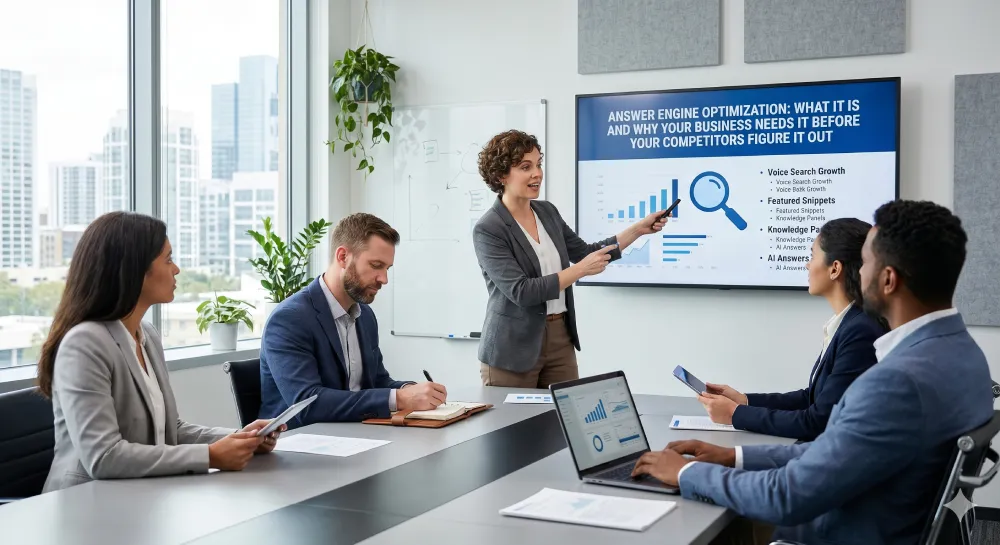
According to Frase’s comprehensive AEO guide, Answer Engine Optimization is “the practice of structuring and enhancing your content so that AI-powered search platforms select it as a cited source when generating answers.” In plain English: AEO is optimizing your content not just to rank on Google, but to be cited and recommended by AI systems — including Google’s AI Overviews, ChatGPT, Perplexity, Gemini, and voice assistants.
Traditionally, SEO was about getting to the top of a ranked list of links. AEO is about being the answer itself — the source that the AI cites when someone asks a question about your industry, your services, or your local area.
What Is the Difference Between AEO and GEO?
You may also see the term GEO — Generative Engine Optimization. As Nowspeed explains, AEO and GEO are closely related, often overlapping concepts:
- AEO (Answer Engine Optimization): Optimizing content to appear as direct answers in AI-powered search results, featured snippets, and voice assistant responses. Focuses on clear Q&A formatting, structured data, and authoritative signals.
- GEO (Generative Engine Optimization): The broader practice of optimizing for inclusion in AI-generated summaries produced by platforms like Google’s AI Overviews, ChatGPT Search, and Perplexity AI. Focuses on content that AI systems will cite and synthesize.
The practical strategies overlap substantially. At BSMG, we use the term AEO because it’s more precise and more actionable for small business marketing. The IQnection AEO overview describes it well: “AEO focuses on clear question-and-answer formatting, structured data, and authoritative signals that help answer engines interpret meaning, context, and intent rather than just keywords.”
Why AEO Matters Right Now for Small Businesses
Three converging trends make AEO an urgent priority for small businesses in 2025 and beyond:
1. AI Overviews Are Already Here
Google AI Overviews — the AI-generated summaries that appear at the top of many search results — now trigger on 40.16% of local business queries. (Source: SEOProfy) When someone searches “best personal injury attorney in [City]” and Google generates an AI Overview summarizing the key considerations — or when someone asks “how do I get a fake review removed” and Google provides an AI-generated answer — businesses that have structured their content for AEO are more likely to be cited as sources.
2. Conversational AI Is a Primary Research Tool
ChatGPT has over 300 million weekly users (Frase AEO guide). Perplexity serves over 100 million queries per week. People are using these tools to research service providers, compare options, and make decisions before they ever open a browser. If your business isn’t represented accurately in the data these systems draw from, you don’t exist for those searchers.
3. Early Movers Win Disproportionately
According to Acquia research cited by Frase, 70% of organizations believe AEO will significantly impact their digital strategy within 1-3 years, but only 20% have begun implementing it. This is the same early-mover dynamic that characterized Google local search 10 years ago — the businesses that optimized early built advantages that took years for competitors to close. The AEO window is open right now. It will not stay open forever.
How AEO Differs from Traditional SEO
Traditional SEO asks: “How do I rank higher in search results?”
AEO asks: “How do I become the answer when someone asks a question?”
The difference is significant. Traditional SEO optimizes for:
- Keywords in content, meta tags, and headings
- Backlinks and domain authority
- Page load speed and technical performance
- Click-through rate from search results
AEO optimizes for:
- Clear, direct answers to specific questions — structured so AI can extract and cite them
- Entity authority — being recognized as a trustworthy, verifiable business entity by AI systems
- Structured data (schema markup) that helps AI understand your business’s context and relationships
- Consistent, authoritative presence across trusted sources (directories, review platforms, industry publications)
- Content that directly addresses the intent behind questions, not just the keywords
The good news for small businesses: you don’t have to choose between traditional SEO and AEO. The best AEO practices reinforce traditional SEO performance. They are not competing strategies — they are complementary ones.
The Local Business AEO Framework: Five Pillars
Pillar 1: Google Business Profile as an AI Data Source
Your Google Business Profile is one of the primary data sources that Google’s AI draws from when generating local business answers. A fully optimized GBP — with accurate NAP, detailed services, active posts, and a strong review base — is not just good for traditional local SEO. It is the foundation of your entity data for AI Overview and Google AI Mode responses. Our Google Business Pro service treats GBP management as a continuous AI data-feeding operation, not a one-time setup.
Pillar 2: FAQ and Q&A Content That AI Can Parse
AEO content is structured to answer specific questions directly and completely. This means FAQ sections on service pages, blog posts organized around specific questions (like this one), and Q&A content in your GBP. When an AI model encounters a clear question-answer pair with authoritative signals, it is more likely to cite that source in its response. Our blog writing service produces content structured explicitly for this format.
Pillar 3: Review Signals as Trust Verification
AI systems use review data as a trust signal when evaluating which businesses to recommend. A business with 200 genuine 5-star reviews on Google is far more likely to be cited as a reputable recommendation than a business with 8 reviews and a 3.9 rating. Our AI Review Builder generates this social proof systematically — not just for traditional SEO performance, but as a core AEO trust signal.
Pillar 4: Citation Consistency Across Authoritative Sources
AI models learn about businesses from the breadth and consistency of their data across authoritative sources. When your business is listed consistently across Google, Bing, Apple Maps, Yelp, industry-specific directories, government licensing databases, and local business associations, AI systems have more data points to validate your entity — which increases citation likelihood. Our citation building service (included in the Gold marketing package) addresses this systematically across 80+ directories.
Pillar 5: Structured Data (Schema Markup)
Schema markup is code added to your website that explicitly tells search engines and AI systems what type of business you are, what services you offer, where you’re located, your hours, your reviews, and more. LocalBusiness schema, FAQPage schema, and Service schema are the most relevant for small businesses. They make your content machine-readable for AI in a way that unstructured text content is not. Our Local SEO & Google Maps Dominance service includes structured data implementation as part of website optimization.
What AEO Looks Like in Practice for a Small Business
Here are concrete examples of what AEO-optimized content looks like for three types of BSMG clients:
For a Personal Injury Law Firm
Blog post titled “What Should I Do Immediately After a Car Accident in [City]?” — written in Q&A format, with specific, actionable answers that Google AI Overview can extract and cite. Service page FAQ section answering “How long does a personal injury case take in [State]?” Service page GBP Q&A entries addressing the top questions injury victims ask. Together, these create multiple AEO touchpoints that increase the probability of AI citation when someone asks an injury question in your market. See our law firm marketing page for more on how this works specifically for attorneys.
For a Plumber or HVAC Contractor
Blog post titled “Why Is My Furnace Making a Banging Noise? (And When to Call a Technician)” — specific question, direct answer, written to be cited by voice assistants and AI Overviews. GBP posts that include educational content answering seasonal questions. Customer-generated reviews that mention specific services (“they fixed my water heater”) provide keyword-rich AEO signals. See our home services marketing page for the full approach.
For a Chiropractor or Medical Practice
Blog posts addressing “How Many Chiropractic Sessions Do I Need for Back Pain?” — a high-AEO-value question that patients ask AI assistants regularly. Service pages that clearly describe each treatment and what conditions it addresses. FAQ sections that directly answer the questions patients are actually asking AI before deciding to book an appointment. Our health and wellness marketing services cover the full AEO strategy for medical and wellness practices.
The BSMG Approach: AEO Built Into Everything We Do
Our marketing packages don’t treat AEO as a separate add-on — it’s built into the framework of everything we produce. Every blog post is structured for both traditional SEO and AI citation. Every GBP post contributes to your entity data. Every review we generate strengthens your AI trust signals. Our full service marketing packages range from Bronze ($995/month) to Gold ($1,995/month) and deliver an integrated AEO + traditional SEO + reputation management system.
70% of organizations believe AEO will significantly impact their strategy within 1-3 years, but only 20% have started. The businesses that start now will have compounding advantages by the time the remaining 80% catch up.
To learn how BSMG can build your AEO foundation, book a free growth strategy call or call (800) 587-0366. We’ll audit your current AI search presence and show you exactly what’s possible.
| Free AI Marketing Audit | Business Solutions Marketing Group | (800) 587-0366 | businesssolutionsmarketinggroup.com | AI-First Marketing Framework |