Domain Authority (DA) is a search engine ranking score developed by Moz that predicts how likely a website is to rank on search engine results pages (SERPs). It is not a Google ranking factor and has no direct effect on the SERPs.
What Is Domain Authority? (And Why Your Law Firm Should Care in 2026)
Domain Authority is a search engine ranking score developed by Moz that predicts a website’s ability to rank in search engine rankings. Domain Authority (DA) is a search engine ranking score developed by Moz that predicts how likely a website is to rank on search engine results pages (SERPs). It is not a Google ranking factor and has no direct effect on the SERPs. This guide is for law firm owners, consultants, and service providers who want to understand what Domain Authority is, why it matters in 2026, and how to improve it. In this article, you’ll learn the definition of Domain Authority, why it’s important, how it’s calculated, and actionable steps to boost your DA score.
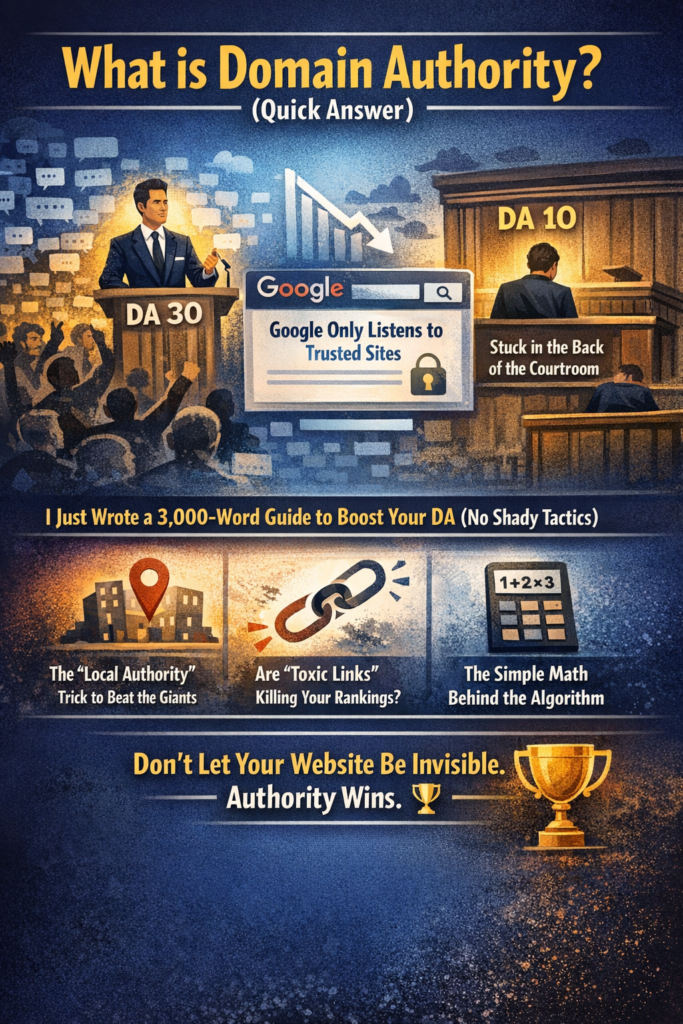
Imagine walking into a courtroom.
You see two lawyers. One is wearing a tailored suit, carries a sleek leather briefcase, and when they speak, the judge leans in to listen. The other is wearing wrinkled clothes, fumbling with papers, and the judge seems to barely notice them.
In the digital world, Domain Authority (DA) is that difference.
It is the measure of your website’s “reputation” in the eyes of search engines. This score, ranging from 1 to 100, is based on factors like backlinks, content quality, and overall site authority. While Domain Authority is not a direct ranking factor used by Google, it strongly correlates with your website’s ability to appear higher in search engine rankings and serves as a useful SEO benchmarking tool.
It determines whether your law firm or service business shows up on Page 1 when a client desperately needs help, or if you are buried on Page 10 where no one will ever find you.
I’m Linda Donnelly, owner of Business Solutions Marketing Group.
For over a decade, I’ve helped small businesses and law firms stop shouting into the void and start dominating their local markets. I have seen trends come and go. I have seen algorithms change overnight. But in 2026, one thing remains crystal clear: Authority wins.
If you are a lawyer, a consultant, or a service provider, you are selling trust. Your website needs to reflect that. But how do you measure trust online? How do you know if Google actually respects your website?
That is where Domain Authority comes in. It’s a metric that feels complicated, but it’s actually quite simple. And mastering it is the key to unlocking a flood of high-quality leads.
Now that you know what Domain Authority is and why it matters, let’s dive into how it’s calculated.
How is Domain Authority Calculated? (The Secret Sauce)
You might be wondering, “Okay Linda, how do I get a high score?”
It’s not magic. It’s math.
While the exact algorithm is a trade secret, we know that DA is calculated by evaluating multiple factors, primarily focusing on your link profile. Calculated domain authority takes into account various ranking factors and backlink data, such as the quality and quantity of backlinks pointing to your site, which together influence your overall score. Other metrics like domain rating (from Ahrefs) are also used in the industry to assess website strength and credibility, providing additional insight into your site’s authority.
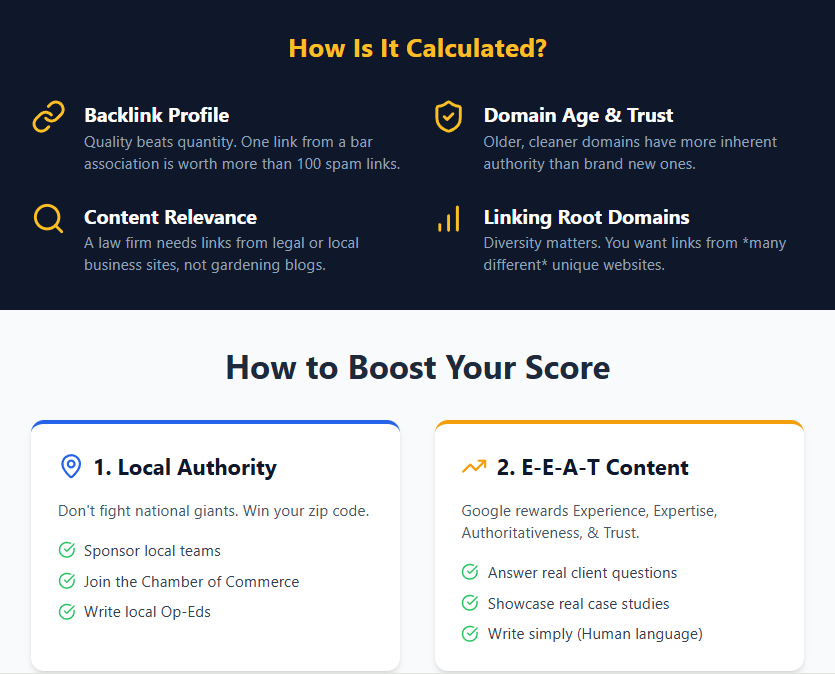
- Backlink Profile: The number and quality of backlinks (links from other websites to yours) are the most important factors. High-quality, relevant backlinks from authoritative sites carry the most weight.
- Linking Root Domains: The diversity of unique domains linking to your site is crucial. More unique, reputable sources mean a stronger DA.
- Domain Age: Older, established domains tend to have higher authority.
- Content Relevance: The relevance of your content and the context of your backlinks matter. Links from sites in your industry or niche are more valuable.
- Other Factors: Moz’s algorithm uses over 40 factors, including spam score, site structure, and more, to calculate DA.
Domain Authority is calculated using a machine learning algorithm that evaluates these factors and predicts how likely your website is to rank compared to others. Remember, DA is a third-party metric developed by Moz and is not used by Google as a ranking factor.
With a clear understanding of how DA is calculated, let’s explore why it’s so important for your law firm’s online success.
The “Credit Score” of the Internet
Think of Domain Authority as your website’s credit score.
Just like a credit score tells a bank how reliable you are with money, your DA score tells Google (and other search engines) how reliable you are with information.
Developed by Moz, DA is a score ranging from 1 to 100.
- 1: A brand new website with zero history.
- 100: Massive sites like Google, Apple, or The New York Times.
DA is just one of several authority scores and domain authority metrics—such as Page Authority and Brand Authority™—used to benchmark a website’s ranking potential, strength, and online reputation.
Most small businesses and law firms sit somewhere in the middle. But here is the kicker: You don’t need a score of 100 to win. You just need a higher score than your direct competitor down the street.
If the Personal Injury firm across town has a DA of 25, and you work hard to get yours to 30, you have a massive advantage. You are the lawyer in the tailored suit. Google is going to listen to you first.
Why does this matter so much in 2026?
Because the internet is noisy. AI-generated content is flooding the web. Everyone has a blog. Everyone has a website. To filter out the junk, Google relies heavily on authority signals. It wants to know, “Who is the real expert here?” A high DA score is your way of raising your hand and saying, “I am.” A higher DA can also improve your search visibility, making it easier for potential clients to find your site.
Now that you understand what Domain Authority is and why it matters, let’s look at the specific factors that influence your score and how you can improve it.
Why Law Firms Struggle with DA (And How to Fix It)
Lawyers are great at arguing in court, but they often struggle to argue their case to Google.
Why? Because the legal industry is competitive. Insanely competitive. In a city like Chicago or New York, you might be fighting against firms with massive marketing budgets who have been building links for 20 years.
But don’t get discouraged! Here is where the “small business advantage” comes in.
You don’t need to beat the national giants. You just need to beat the other firms in your zip code. Improving your website’s performance and overall SEO performance requires consistent SEO efforts—focusing on all aspects of SEO, not just Domain Authority, to stay ahead of local competitors.
The “Local Authority” Strategy
Instead of trying to get a link from the Wall Street Journal (which is hard), focus on your backyard.
- Sponsor a Little League team: Get a link from the league’s website.
- Join the local Bar Association: Make sure your profile has a link to your site.
- Write an Op-Ed for the local paper: Offer your legal expertise on a community issue.
- Contribute link worthy content to authoritative sites and reputable websites in your community or industry: Share original research, expert guides, or helpful resources that local organizations, news outlets, or industry associations will want to link to.
These local links are gold for Local SEO. They tell Google, “This lawyer isn’t just an expert; they are a local expert.” And when someone searches “Lawyer near me,” that local relevance is what pushes you to the top of the map pack.
Ready to see how content quality and E-E-A-T can further boost your authority? Let’s dive in.
The Content Connection: E-E-A-T
In 2026, you cannot talk about Domain Authority without talking about E-E-A-T.
- Experience
- Expertise
- Authoritativeness
- Trustworthiness
Google’s search raters use this framework to judge content. While E-E-A-T isn’t a direct ranking factor like a backlink, it deeply influences your DA over time.
Experience
Showcase your real-world legal experience through case studies, testimonials, and practical advice. Demonstrating hands-on experience builds trust with both users and search engines.
Expertise
Publish high-quality, helpful articles that answer real client questions (like “What happens to my 401k in a divorce?”). Aligning your content with search intent and focusing on content quality helps you earn backlinks naturally, as your articles meet what users are actually searching for and provide real value.
Authoritativeness
Get cited by other reputable websites, legal directories, and local organizations. The more your expertise is recognized by others, the higher your perceived authority.
Trustworthiness
Be transparent about your credentials, provide clear contact information, and maintain a secure, user-friendly website. Trust signals help both users and search engines feel confident in your site.
This is organic link building. It’s slow, but it’s powerful. Natural backlinks from other websites are a strong signal of authority.
Stop writing boring “legal updates” that only other lawyers understand. Write for your clients! Write about their pain points. Use human language. Be the helpful expert. When you provide value, authority follows.
Next, let’s talk about how to monitor your DA and what to do if your score changes.
Monitoring Your Score (Don’t Be Obsessive)
There are plenty of free tools to check your DA (Moz, Ahrefs, SEMrush). Go ahead and check yours. Is it 10? 20? 50? You can also use a domain authority checker or authority checker to evaluate your site’s authority, analyze your backlink profile, and monitor your progress over time.
Whatever the number is, don’t panic.
DA fluctuates. It’s a comparative metric. If the New York Times gains a billion new links, everyone else’s score might drop slightly by comparison. That doesn’t mean you did anything wrong.
Use DA as a benchmark, not a report card. Check it once a quarter. Is it trending up? Good. Is it flatlining? Time to build some new relationships and earn some new links. Is it crashing? You might have toxic backlinks pointing to your site that need to be disavowed. Tools like Moz’s Link Explorer can help you identify and remove harmful links to protect your site’s authority.
Now that you know how to track your progress, let’s look at the best practices for boosting your law firm’s Domain Authority.
Best Practices for Law Firm Domain Authority
Building a strong Domain Authority (DA) isn’t just about chasing numbers—it’s about creating a website that search engines trust and real people want to visit. For law firms, a higher domain authority means your site is more likely to appear at the top of search engine result pages, bringing in more organic traffic and, ultimately, more clients. Here’s how your firm can boost its DA score and stand out in a crowded legal market:
- Create High-Quality, Relevant Content:
Consistently publish valuable content that addresses your clients’ real questions—think detailed guides on birth injury claims, FAQs about medical malpractice, or updates on product recalls affecting children. High quality content not only attracts visitors but also encourages other reputable sites to link to your pages, increasing your domain authority. - Earn High Quality Backlinks from Authoritative Legal and Local Sites:
Focus on building relationships with respected organizations in the legal and medical fields. Get listed in reputable legal directories, contribute guest articles to industry publications, and seek mentions from local news outlets or advocacy groups. Each high quality backlink acts as a vote of confidence, helping your DA score climb. - Optimize Your Technical SEO:
A well-structured, fast, and secure website is essential. Make sure your site loads quickly, is mobile-friendly, and uses HTTPS. Fix broken links, optimize your internal linking structure, and ensure your site is easy for search engines to crawl. Technical SEO improvements support your website’s performance and help search engines recognize your site as trustworthy. - Leverage Local SEO and Citations:
Claim and optimize your Google Business Profile, and ensure your law firm is listed accurately on local directories and legal association websites. Local citations from trusted sources can boost your domain authority and help you rank higher for searches in your area, driving more organic traffic from potential clients nearby. - Monitor and Clean Up Your Backlink Profile:
Regularly review your backlink profile to identify and disavow toxic or spammy links that could harm your DA score. Use tools like Moz’s Link Explorer or Ahrefs to track domain authority and ensure your site is only associated with reputable, relevant domains. - Encourage Natural Link Building Through Community Involvement:
Sponsor local events, participate in community initiatives, or offer expert commentary to journalists. These activities often result in natural, high quality backlinks from local organizations and media, further boosting your domain authority and visibility on search engine result pages.
By following these best practices, your law firm can steadily increase its domain authority, attract more organic traffic, and secure a stronger presence in search results. Remember, improving your DA score is a long-term investment—but one that pays off with more visibility, credibility, and client inquiries.
Let’s wrap up with the key takeaways you need to remember about Domain Authority.
Key Takeaways for Improving Your Domain Authority Score
- It’s a Credit Score: DA measures your website’s trustworthiness on a scale of 1-100.
- Context is King: You don’t need a score of 100; you just need a higher score than your local competitors.
- Links are Votes: High-quality backlinks from reputable sites are the fastest way to boost your score.
- Local Wins: For law firms, links from local organizations (Chamber of Commerce, charities) are often more valuable than generic national links.
- Content Fuels Authority: Writing helpful, human-centric content attracts the kind of natural links that Google loves.
- Boost Your Rankings: Focusing on high-quality content and acquiring strong backlinks can increase domain authority, improve your website’s domain authority, and help boost your search rankings.
Still have questions? Check out the FAQ below for more answers.
Frequently Asked Questions About Domain Authority for Lawyers
1. Can I pay Google to increase my Domain Authority?
Answer: No. You cannot buy a higher DA score from Google. It is an earned metric based on organic signals. While you can pay for SEO services to help build links, you cannot directly pay the search engine to trust you more. Also, Domain Authority is not a Google ranking factor—Google does not use DA in its algorithms.
2. How long does it take to improve my DA score?
Answer: It is a marathon, not a sprint. Typically, you might see small improvements in 3-6 months of consistent effort. Jumping from DA 10 to DA 20 is relatively easy; jumping from DA 50 to DA 60 takes massive effort.
3. Does social media affect my Domain Authority?
Answer: Not directly. Google has stated that social signals (likes, shares) are not a direct ranking factor. However, a viral post gets more eyeballs on your content, which increases the likelihood that someone will link to it from their own website, indirectly boosting your DA.
4. What is a “good” Domain Authority score for a law firm?
Answer: It depends entirely on your competition. If your competitors average a DA of 20, then a 25 is excellent. Generally, for a local business, anything between 20-30 is a solid foundation. 40+ is very strong.
5. Can I lose Domain Authority?
Answer: Yes. If you lose high-quality backlinks (websites go offline or remove your link), your score can drop. Also, if your competitors gain links faster than you, your comparative score might dip.
6. What are “Toxic Links”?
Answer: These are links from spammy, low-quality, or irrelevant websites (often gambling or adult sites). Google hates these. If you have too many, they can drag your authority down or even trigger a penalty.
7. Why does my competitor rank higher than me with a lower DA?
Answer: DA is just one metric. Google looks at hundreds of factors, including page speed, mobile-friendliness, and on-page keyword optimization. A lower-DA site might have better specific content for that particular search query.
8. Should I buy backlinks?
Answer: Be extremely careful. Buying links violates Google’s guidelines. If you get caught, your site can be de-indexed (removed from Google entirely). Focus on “earning” links through PR and partnerships instead.
9. Does DA affect my Google Maps ranking?
Answer: Yes! Organic authority influences your “Prominence” in the local map pack. A strong website helps lift your Google Business Profile higher in the maps. However, keep in mind that Domain Authority is not a direct Google ranking factor. It is a third-party metric, but higher DA often correlates with better performance in Google search results because it reflects the strength and trustworthiness of your site compared to competitors.
10. Is Page Authority (PA) different from Domain Authority (DA)?
Answer: Yes. DA measures the strength of your entire domain or subdomain, predicting how likely your whole site is to rank in Google search results. PA, on the other hand, measures the ranking potential of an individual page (like a specific blog post) within that domain. You might have a high DA for your entire domain, but a specific new page might have low PA until it earns its own links.
Look, I know you didn’t go to law school to worry about backlinks and algorithms. You want to serve your clients.
But in 2026, your digital reputation is just as important as your courtroom reputation. You can be the best lawyer in the world, but if Google doesn’t trust you, clients won’t find you.
At Business Solutions Marketing Group, we handle the heavy lifting. We build the links, write the content, and monitor the metrics so you can focus on winning cases.
Ready to see where you stand? Let’s do a quick audit of your current Domain Authority and see how you stack up against your top three competitors.
Sources:
- Moz. “What is Domain Authority?” Moz Learning Center, 2025. Link to Source
- Search Engine Journal. “The Truth About Domain Authority: A Guide for Lawyers.” SEJ, 2026. Link to Source
- Ahrefs. “Link Building Strategies for Local Service Businesses.” Ahrefs Blog, 2025. Link to Source
GBP LInk – https://g.co/kgs/GR8yH4a
LinkedIn – https://www.linkedin.com/company/business-solutions-marketing-group-llc/?viewAsMember=true
Instagram – https://www.instagram.com/business_solutions_mg/
Twitter – https://x.com/BSMGLLC
Facebook – https://www.facebook.com/BusinessSolutionsMarketingGroup
BlueSky: https://bsky.app/profile/bussolutions.bsky.social
TikTok – https://www.tiktok.com/@linda_donnelly
YouTube – https://www.youtube.com/channel/UC4w357-txvxOaHff2hTfSSg