“Wait… was that a real person?”
If you haven’t asked yourself that question yet while scrolling through TikTok or LinkedIn this week, you aren’t looking closely enough!
We have officially crossed the threshold. Back in 2023, AI avatars looked like jittery video game characters from the 90s. Their lips didn’t quite match the words, and their eyes had that vacant, “I’m secretly a robot planning world domination” stare. But let me tell you, friends—2026 is a different beast entirely.
As a marketing expert who has watched this technology evolve from a clumsy toddler into an Olympic sprinter, I’m seeing a massive shift in how small businesses are handling video. The days of needing a $10,000 budget, a lighting crew, and a diva actor to film a 30-second ad are fading fast.
But does that mean you should replace every human face in your marketing with a digital clone? Not exactly.
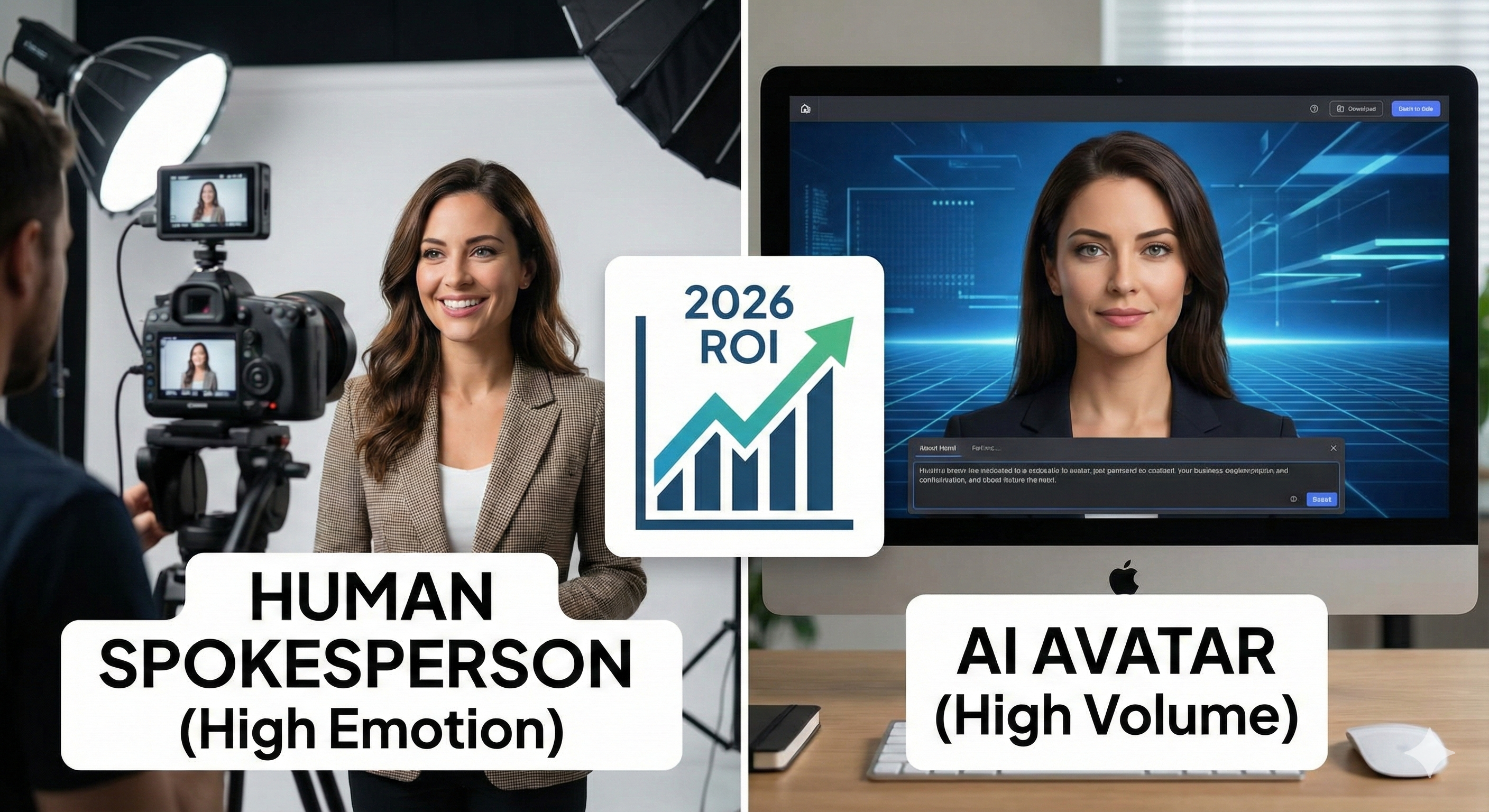
Let’s strip away the hype and look at the cold, hard numbers. As we move into 2026, here is the real cost-benefit analysis of AI Avatars vs. Human Spokespeople for your business.
The “Uncanny Valley” in 2026: Is It Finally Dead?
First, we have to address the elephant in the server room: The Uncanny Valley.
This is that creepy feeling you get when something looks human but isn’t quite right. For years, this was the death knell for AI video. If your customers felt creeped out, they wouldn’t buy your plumbing services or your consulting package.
The verdict for 2026? The valley has been bridged.
Recent data from late 2025 suggests that 65% of consumers can no longer distinguish between a high-end AI avatar (using 2026-level rendering) and a human actor in short-form content [1]. The jitter is gone. The micro-expressions—the tiny furrow of a brow or a natural pause for breath—are now baked into the code.
Tools like HeyGen and Synthesia have moved from “text-to-video” to “emotion-to-video.” You can now direct an avatar to look “concerned” or “excited,” and the AI actually nails it.
The Cold Hard Cash: Cost Comparison
Let’s talk about your favorite subject: the budget.
For a small business owner, video marketing has always been a “pay to play” game. You either paid with money (hiring a pro) or you paid with time (trying to film yourself with a ring light and stumbling over your words for three hours).
Here is the breakdown of what a 5-minute educational video series costs in 2026:
Option A: The Traditional Human Route
- Professional Actor: $500 – $1,500/day
- Videographer/Editor: $1,000 – $3,000
- Studio Rental/Equipment: $500
- Time to Market: 2-3 weeks (scheduling, shooting, editing revisions)
- Total Estimated Cost: $2,000 – $5,000+
Option B: The AI Avatar Route
- AI Software Subscription: $30 – $100/month
- Actor Fees: $0 (Included in software)
- Studio/Equipment: $0
- Time to Market: 2 hours (Script input, rendering, minor tweaks)
- Total Estimated Cost: $300 (or less)
Source: 2025 Video Production Cost Analysis [2]
The ROI is undeniable. If you need to produce volume—like daily social media updates, personalized sales follow-ups, or training modules—AI wins on price every single time. You can produce 50 videos for the price of one human-produced commercial.
When to Use Humans (Because We Still Matter!)
Okay, so robots are cheaper. Does that mean humans are obsolete? Absolutely not!
There is a “trust premium” that comes with a real human being. While AI is great for information, humans are still king for connection.
Stick with a Human When:
- It’s a Founder Story: If you are telling the emotional story of why you started your bakery, use your real face. People connect with your vulnerability, flaws, and genuine passion. AI cannot replicate the “soul” in your eyes yet.
- Crisis Management: If you messed up and need to apologize to customers, do not—I repeat, DO NOT—use an AI avatar. It looks calculated and cold.
- High-End Brand Commercials: If you are selling a luxury experience, the “imperfections” of real film (grain, lighting, atmosphere) signal quality.
Switch to AI Avatars When:
- Educational Content: “How to change a furnace filter” doesn’t need a soulful performance; it needs clarity.
- Personalized Sales Outreach: Imagine sending 500 emails where the video says the client’s name perfectly. “Hey Sarah, I saw your website…” You can’t record that 500 times. AI can do it in minutes.
- Multilingual Content: This is the killer app. You can record one video in English, and with one click, your AI avatar is speaking fluent Spanish, Mandarin, and German, with the lip movements perfectly synced.
The Verdict: It’s Not “Either/Or,” It’s a Hybrid Strategy
The smartest businesses in 2026 aren’t choosing sides; they are building a hybrid team.
Think of your AI avatar as your “Digital Intern.” It handles the grunt work. It answers FAQs at 2 AM. It records the weekly newsletter updates. It never gets sick, never asks for a raise, and never has a bad hair day.
Meanwhile, you (the human) are the “Premium Brand Ambassador.” You show up for the big moments. You do the live streams. You shake hands.
By offloading the repetitive video tasks to AI, you free yourself up to be more human where it counts.
Key Takeaways
- The Trust Gap is Closing: 65% of viewers can’t tell the difference in short clips anymore.
- Volume = AI: If you need daily content, AI is the only way to scale without burning out.
- Emotion = Human: Keep real people for founder stories, apologies, and high-stakes emotional connection.
- Global Reach: AI allows you to speak 40+ languages instantly, opening up new markets for small local businesses with diverse demographics.
- Cost Savings: AI production is roughly 95% cheaper than traditional video production for standard content.
Common Questions About AI Avatars
- Q: Will Google penalize my SEO for using AI videos? A: No! Google indexes video content based on relevance and engagement. As long as the content is helpful and people watch it, Google doesn’t care if a human or an avatar delivered the message. In fact, having more video content usually boosts SEO.
- Q: Can I make an avatar that looks like me? A: Yes! “Digital Twins” are huge in 2026. You record 5 minutes of footage once, and the software builds a clone of you. You can then type text, and “you” will say it. It’s perfect for maintaining your personal brand without the camera time.
- Q: Is it legal to use these actors? A: If you are using stock avatars provided by platforms like HeyGen or Synthesia, yes. Those actors were paid for their likeness rights. Be very careful about cloning celebrities or people without permission—that is a fast track to a lawsuit.
- Q: Do I need special equipment? A: Zero. That’s the beauty of it. You don’t need a camera, a microphone, or a quiet room. You just need a laptop and a script.
- Q: Will customers get mad if they find out? A: Transparency is key. We recommend a small “AI-Assisted Content” note for transparency, but most data shows customers prefer a quick, clear AI video answer over reading a long PDF document any day.
Sources: [1] Wyzowl Video Marketing Statistics 2024 (Consumer perception data) [2] Synthesia vs Traditional Cost Analysis 2025 (Cost breakdown data) [3] HubSpot State of Marketing Report 2025 (General AI adoption trends)
GBP LInk – https://g.co/kgs/GR8yH4a
LinkedIn – https://www.linkedin.com/company/business-solutions-marketing-group-llc/?viewAsMember=true
Instagram – https://www.instagram.com/business_solutions_mg/
Twitter – https://x.com/BSMGLLC
Facebook – https://www.facebook.com/BusinessSolutionsMarketingGroup
BlueSky: https://bsky.app/profile/bussolutions.bsky.social
TikTok – https://www.tiktok.com/@linda_donnelly
YouTube – https://www.youtube.com/channel/UC4w357-txvxOaHff2hTfSSg