Are you a business owner or marketer wondering, “Why is my organic traffic declining?” If so, you’re not alone—and you’re in the right place. This article explains the most common reasons for organic traffic drops and provides actionable strategies to recover and protect your business. Understanding these causes is crucial because organic traffic is often the lifeblood of your revenue and business stability. A sudden or gradual decline can directly impact your bottom line, making it essential to diagnose and address issues quickly.
Who Should Read This?
This guide is designed for business owners and marketers who rely on their website for leads, sales, or brand visibility. Whether you’re managing your own site or overseeing a marketing team, the insights here will help you understand, diagnose, and solve organic traffic declines.
Why Does This Matter?
Organic traffic—visitors who find your website through unpaid search engine results—is a key driver of sustainable growth. When organic traffic drops, so does your revenue, lead flow, and long-term business stability. Knowing why these declines happen and how to respond is essential for protecting your business from sudden shocks and ensuring ongoing success.

Glossary: Key Terms Explained
- Organic Traffic: Visitors who arrive at your website through unpaid search engine results, as opposed to paid ads. Understanding the difference between informational and commercial intent traffic is crucial for evaluating the impact of traffic changes on your website’s performance.
- Algorithm Update: Changes made by search engines like Google to their ranking systems, which can shift how websites are ranked and reduce visibility overnight.
- Search Intent: The underlying reason behind a user’s search query—what they are hoping to find or accomplish. Changes in user behavior and search intent can lead to fluctuations in organic traffic, regardless of your website’s ranking.
- Single-Channel Dependency: Relying on one marketing channel (such as Google organic search) for the majority of your website traffic and revenue, which increases risk if that channel’s performance declines.
Most Common Causes of Organic Traffic Decline
Understanding why your organic traffic is declining is the first step to recovery. Here are the most frequent causes, whether your drop is sudden or gradual:
- Sudden Drops: Often caused by technical issues (like broken links, server downtime, or accidental changes to robots.txt), manual penalties from search engines, or major algorithm updates.
- Gradual Drops: Typically result from content decay (outdated or irrelevant content), increased competition, or shifts in user intent.
- Algorithm Updates: Search engines regularly update their algorithms, which can change how your site is ranked and reduce visibility overnight.
- Technical SEO Issues: Problems like slow page load speeds, poor mobile usability, or confusing site architecture can prevent search engines from crawling and indexing your site.
- Content Quality: A drop in the quality or relevance of your content can lead to a decrease in organic traffic.
- User Intent Shifts: If your content no longer matches what users are searching for, your traffic may decline even if your rankings remain stable.
- Increased Competition: Competitors improving their strategies can attract your audience and lead to a drop in your organic traffic.
- SERP Feature Changes: The introduction of new search engine results page (SERP) features can reduce the need for users to click on traditional links, decreasing organic traffic.
- Loss of Inbound Links: Losing backlinks can decrease your website’s authority and rankings.
Why Is My Organic Traffic Declining? – Key Takeaways
Below is a table summarizing the key risks and strategies for addressing organic traffic decline, along with recommended action steps:
| Risk/Strategy | Description | Action Step |
|---|---|---|
| Single-Channel Risk | Relying 90%+ on traditional Google organic traffic puts your revenue at the mercy of sudden algorithm changes. | Monitor competitors, diversify channels, and analyze multiple factors influencing traffic drops. |
| Ads Are Not Assets | Paying for ads is a temporary fix; you’re renting an audience, not building long-term brand equity. | Invest in content and owned assets to build sustainable traffic sources. |
| Content is Your Foundation | Consistent content marketing builds a library of assets that fuel your email lists and social channels. | Leverage SERP features and adapt content to changing user intent and global events. |
| Maps and Reputation Rule Local | Optimizing your Google Business Profile and managing reviews secures your spot in the Local Map Pack. | Use a system for managing reviews and tailor local SEO strategies by location. |
| Video Diversifies Instantly | AI Avatar Video Marketing allows you to dominate YouTube and social media, building trust quickly. | Incorporate video into your marketing mix to reach new audiences and build credibility. |
| The Gold Package Solves the Problem | A multi-pillar approach guarantees your business captures attention and market share across platforms. | Implement a diversified marketing strategy to mitigate risks and improve performance. |
Is Your Business One Algorithm Update Away from Disaster? The Danger of the “Google-Only” Strategy.
If you were completely dependent on one marketing channel like Google, and your traffic dipped last month, chances are your revenue did too. Maybe not at the exact same rate, but you definitely felt the hit!
I am Linda Donnelly, owner of Business Solutions Marketing Group. Over the last decade of helping small businesses grow, I have watched the digital landscape completely transform. And right now, I am seeing a terrifying trend among hard-working business owners.
Single-channel dependency is the new ultimate risk.
For years, the playbook was easy: optimize your website for Google, fight for those ten blue links, get the traffic, and make the sales. But that playbook is breaking down. Between massive core algorithm updates, the rise of AI Overviews pushing regular websites down the page, and competitors crowding the space, that free traffic pie is shrinking.
If most of your revenue comes from traditional organic traffic, and that traffic keeps declining, what is your actual backup plan?
Here is the hard truth. Just spending more money on paid ads isn’t a real backup plan! It is just renting a more expensive digital apartment on the exact same shaky ground.
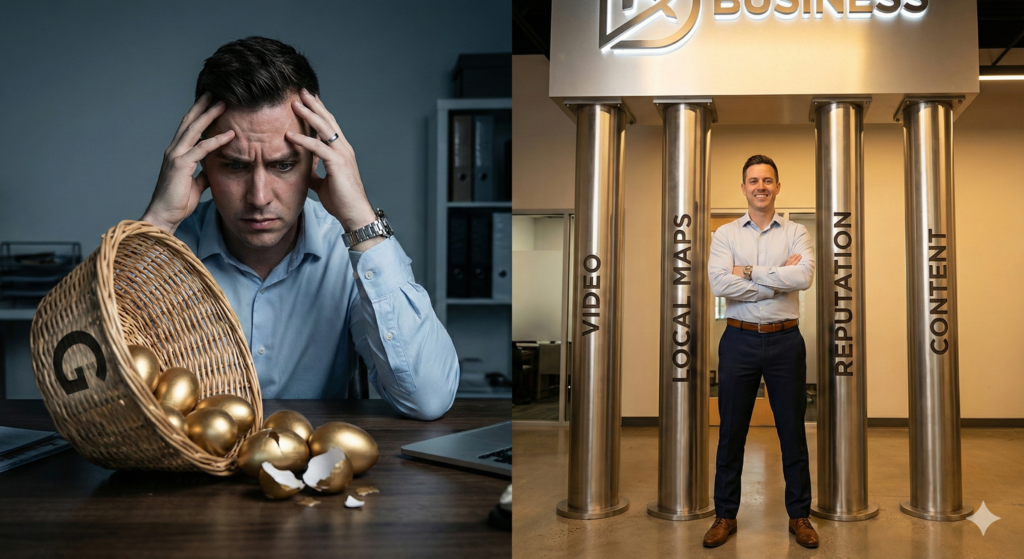
You need to stop building your entire business on rented land. You need a multi-pillar marketing strategy that captures attention everywhere your buyers are spending their time.
Now that you understand the risks of single-channel dependency, let’s explore why relying solely on Google is no longer enough and how to diversify your marketing for stability.
The Reality Check: Why the “Google Basket” has Holes
I want to be clear: I love search engine marketing. It is a vital part of what we do. But relying on traditional organic search as your only lifeline is incredibly dangerous.
Google does not owe your small business visibility. Their primary goal is to keep users on their own platform and sell advertising space. We are seeing a massive shift right now with Generative AI. If your entire strategy relies on someone scrolling past the sponsored ads, scrolling past the AI summary, and clicking the fourth organic result, you are fighting a losing battle.
When that organic traffic suddenly dips, the knee-jerk reaction is usually panic. Business owners immediately dump thousands of dollars into Google Ads or Meta Ads to bridge the gap.
Paid ads are fantastic for immediate visibility, but relying on them as your only alternative is flawed. It gets more expensive every single year. Furthermore, the second you stop paying, the traffic stops instantly. You aren’t building a long-term asset; you are just feeding a meter.
With the limitations of single-channel and paid strategies clear, let’s look at how a diversified approach can safeguard your business.
The Diversification Playbook: Enter the Gold Marketing Package
If we cannot rely solely on traditional Google SEO, and we cannot just buy our way out of the problem forever, what is the solution?
We diversify. We build a marketing ecosystem where if one channel shifts, the others easily pick up the slack.
At Business Solutions Marketing Group, we saw this shift coming. That is exactly why we engineered our Gold Marketing Package. We designed it specifically to break small businesses out of the single-channel trap and build an undeniable, omnipresent brand.
Here is how a true, multi-pillar strategy bulletproofs your business:
1. Content Marketing (Building Your Owned Assets) You need to create assets that actually belong to you. Consistent, high-quality content marketing does exactly that. By publishing deep, authoritative blog posts and guides, you aren’t just chasing random keywords. You are building a library of resources that fuels your social media, feeds your email newsletter, and answers the exact questions your buyers are asking. According to HubSpot, companies with blogs produce an average of 67% more leads monthly than companies that don’t. Content is the foundation of an independent brand.
2. Google Business Optimization (Dominating the Map Pack) Traditional organic links are getting pushed down, but local intent is stronger than ever. The Google Map Pack (that block of three local businesses at the top of the page) is incredibly resilient to standard algorithm updates. By aggressively optimizing your Google Business Profile, we ensure that when someone in your city needs your service right now, you are the undeniable local choice. It is a completely different (and highly profitable) ecosystem than standard website SEO.
3. Reputation Management (The Ultimate Trust Signal) Having a great service isn’t enough anymore; you have to prove it to the algorithms. Both human buyers and AI Overviews rely heavily on consensus. If an AI reads hundreds of glowing reviews about your business, it will confidently recommend you. According to a recent BrightLocal survey, 88% of consumers trust online reviews as much as personal recommendations. Our Gold Package includes aggressive reputation management because your reviews are the ultimate shield against losing market share.
4. AI Avatar Video Marketing (Omnipresent Human Connection) This is the ultimate game-changer for diversification. People buy from people, and video builds trust faster than any other medium. According to Wyzowl, 88% of people say they’ve been convinced to buy a product or service by watching a brand’s video. However, most business owners are too busy to sit in front of a camera all day! With our AI Avatar Video Marketing, we create professional, highly engaging video content for YouTube, TikTok, and Instagram without you ever having to step into a studio. This opens up entirely new, massive search engines and social platforms, driving high-intent buyers to your business without relying on a single Google search.
Now that we’ve explored diversification, let’s look at how to diagnose and recover from a traffic drop.
Diagnosing and Addressing Organic Traffic Decline
Before diving into solutions, it’s important to understand the process for diagnosing and addressing a drop in organic traffic. Whether your decline is sudden or gradual, a structured approach will help you pinpoint the root cause and take effective action.
Technical Issues and Traffic
Common Technical Issues
Technical issues can have a dramatic impact on your website’s traffic, especially following a Google algorithm update. Problems such as slow page load times, broken links, poor mobile usability, and confusing site architecture can all lead to a sudden drop in organic traffic. These issues not only frustrate users but also make it harder for search engines to properly crawl and index your site.
How to Monitor Technical Health
To stay on top of technical issues, it’s essential to regularly monitor your website using tools like Google Search Console. This platform provides detailed insights into your site’s performance, highlighting errors and areas that need attention.
Proactive Optimization Tips
By analyzing this data, you can quickly identify and resolve technical problems before they affect your rankings or user experience. Proactive technical optimization should be a core part of your SEO strategy, ensuring your site remains accessible, fast, and user-friendly. Addressing these issues promptly helps you recover from traffic drops and positions your website for long-term success in Google search results.
With technical health in check, let’s move on to the step-by-step process for recovering from a traffic drop.
Recovering from a Traffic Drop
Experiencing a sudden drop in website traffic can be alarming, but with a focused SEO strategy, recovery is possible. Here’s a step-by-step approach:
Step 1: Analyze Search Console Data
- Review your Google Search Console data to pinpoint the root causes—whether it’s a Google algorithm update, technical issues, or a mismatch with search intent.
- Establish the scope of the decline and identify where it is coming from (e.g., specific pages, locations, or device types).<sup>12,13,14,27</sup>
Step 2: Optimize Content
- Update and optimize your content to better align with what your audience is searching for, ensuring it’s valuable, relevant, and up-to-date.<sup>5,6,18,22</sup>
- Adapt your content to reflect recent changes in user behavior and Google’s algorithm.
Step 3: Address Technical Issues
- Identify and resolve technical problems such as slow load times, broken links, or crawl errors.<sup>3,19,20,21,26</sup>
- Ensure your site is accessible, mobile-friendly, and easy to navigate.
Step 4: Build Backlinks and Diversify Channels
- Build high-quality backlinks to increase your website’s authority.<sup>17,23</sup>
- Leverage other channels, such as content marketing and social media, to drive new traffic and diversify your sources.<sup>24,25</sup>
Step 5: Manage Reputation
- Monitor reviews, engage with clients, and consistently create valuable content to build trust and authority in your field.
Staying informed about the latest Google algorithm changes and continuously refining your SEO efforts will help you not only recover lost traffic but also improve your site’s long-term performance and visibility. By focusing on quality, technical excellence, and audience engagement, your website can bounce back stronger and more resilient than before.
With a recovery plan in place, let’s address some frequently asked questions about search intent and organic traffic.
Frequently Asked Questions About Search Intent
1. Is traditional SEO dead for small businesses?
Absolutely not! It is still a vital source of high-intent traffic. However, it should be just one piece of your strategy, not the entire puzzle. You must diversify to protect yourself.
2. Why isn’t spending more on Google Ads a good long-term backup plan?
Ad costs rise consistently as more businesses crowd the platform. Furthermore, when you turn your ad budget off, the phone instantly stops ringing. It is a fragile strategy compared to building owned assets.
3. What exactly is AI Avatar Video Marketing?
It is a cutting-edge service where we use advanced AI to create lifelike, professional video spokespersons delivering your branded content. It allows you to produce massive amounts of high-quality video for social media and YouTube without needing a camera crew!
4. Why is the Google Business Profile (Map Pack) different than regular SEO?
The Map Pack is driven by proximity, reviews, and local optimization rather than traditional website backlinks. It is often insulated from the wild swings of standard organic core algorithm updates.
5. How does Reputation Management protect me from algorithm updates?
AI search engines (like SGE) scrape the internet for consensus. If you have hundreds of highly positive, keyword-rich reviews across multiple platforms, AI models will recommend your business regardless of where your website ranks organically.
6. I don’t have time to write blogs. How does Content Marketing work?
That is why you hire an agency! In our Gold Package, our experienced team of marketers handles the research, writing, and publishing of high-value content—including comprehensive articles and engaging blog posts—that attracts your ideal buyers.
7. How many marketing channels should a small business actively use?
A healthy, resilient mix usually includes a strong local presence (Google Business), an active video strategy (YouTube/Social), foundational content (Blogging/Email), and proactive reputation management. Monitoring blog performance also helps you understand user intent and traffic trends.
8. Is video really that important for B2B or local service businesses?
Yes. Video is the fastest way to build trust. If a homeowner needs a plumber, watching a helpful 60-second video about your emergency services will convert them much faster than reading a wall of text.
9. How long does it take to see results from a multi-pillar strategy?
While things like Google Business Optimization can yield quicker local wins, building a true omnichannel presence with video and deep content usually takes 3 to 6 months of consistent execution to see compounding revenue growth.
10. How do I switch from my current “Google-Only” strategy to the Gold Package?
It is incredibly easy. Reach out to our team at Business Solutions Marketing Group for a free consultation. Our expert marketers will audit your current single-channel risk and show you exactly how our four pillars will secure your growth.
GBP LInk – https://share.google/C8gU1JB3P6mPKWplN
LinkedIn – https://www.linkedin.com/company/business-solutions-marketing-group-llc/?viewAsMember=true
Instagram – https://www.instagram.com/business_solutions_mg/
Twitter – https://x.com/BSMGLLC
Facebook – https://www.facebook.com/BusinessSolutionsMarketingGroup
BlueSky: https://bsky.app/profile/bussolutions.bsky.social
TikTok – https://www.tiktok.com/@linda_donnelly
YouTube – https://www.youtube.com/channel/UC4w357-txvxOaHff2hTfSSg