A year ago, everyone in business was obsessed with one question: “How do I rank higher on Google?”
Today, that question feels almost quaint. Millions of people are opening ChatGPT, Claude, and Perplexity and asking things like:
- “Who’s the best HVAC company near me?”
- “Can you recommend a good dentist?”
- “What’s the best marketing agency?”
- “What’s the best CRM for my business?”
Notice the difference? People aren’t searching anymore. They are asking AI to recommend. And that shift raises a massive, existential question for business owners everywhere: Why does AI recommend one business—and completely ignore another?
Having spent over a decade helping small businesses grow through strategic marketing at Business Solutions Marketing Group, I have watched the ground shift beneath our feet. We are no longer just fighting for a spot in a list of blue links. We are fighting to become the singular, trusted answer inside an algorithm’s neural network.
If your phone has gone quiet while your competitors are suddenly landing high-intent, pre-sold leads straight from AI chatbots, this post is your wake-up call. Let’s break down how AI search actually works and how you can force it to choose you.
🔑 Key Takeaways
- The Death of the Keyword: AI search is built on synthesis and citations, not keyword density or basic on-page SEO.
- Share of Model: Success is no longer measured by rank position, but by how often an LLM cites your brand when answering a user’s prompt.
- The Trust Trail: AI models don’t just read your website; they look at third-party validation, industry mentions, and structured data across the wider web.
- Actionable Fixes: To win AI recommendations, you must optimize for Generative Engine Optimization (GEO) by embedding hard data, clear definitions, and expert citations into your content.
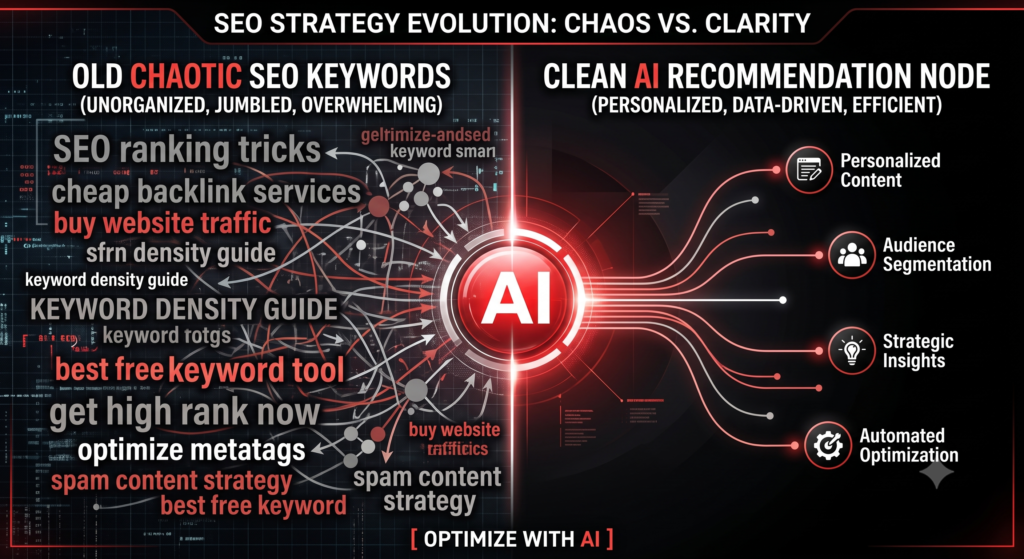
Custom Visual Concept: The AI Recommendation Divide
- Image Concept: A stark, minimalist split-screen photo rendered in a punchy red, black, and white color palette. On the left side (black background with harsh white text), a chaotic tangle of traditional keyword strings fades into digital static. On the right side (crisp white background with bold red accents), a glowing, singular data node connects cleanly to a glowing recommendation bubble that reads: “Recommended: Business Solutions Marketing Group.” The stark contrast highlights the evolution from old-school search clutter to modern AI clarity.
The Great Behavioral Shift: From Searching to Asking
Let’s look at the numbers. Recent industry data shows that roughly 35% of consumers now use AI tools at the product and service discovery stage, completely bypassing traditional search engines. Even more striking? Google’s own AI Overviews now touch over a quarter of all search queries, pushing traditional organic search results further down the page and accelerating the rise of zero-click searches.
When a potential customer opens ChatGPT or asks Google’s AI mode for a recommendation, they aren’t browsing. They are delegating.
Think about how you use these tools yourself. When you ask an LLM to recommend a local provider, you don’t want ten options and a homework assignment to compare them. You want an immediate, authoritative shortlist.
When the AI compiles that shortlist, it isn’t running a traditional keyword match to see who stuffed “best marketing agency” into their title tag the most times. It is synthesizing billions of data points to answer a single underlying prompt: “Who does this model trust the most?”
If your business isn’t part of that web of trust, you are invisible.
How AI Decides Who Wins (And Why It Ignores You)
To understand why an AI recommends your competitor, you have to understand how large language models (LLMs) consume information. They rely on a discipline we now call Generative Engine Optimization (GEO).
Here are the primary reasons your business is getting left out of the conversation:
1. You Live Only on Your Own Website
Traditional SEO taught us to optimize our own domain—tweak our landing pages, build backlinks, and optimize our title tags. But AI models are radically egocentric about external validation.
Research published by Ahrefs and major marketing analysts reveals that brand mentions across the broader web correlate up to three times more strongly with AI visibility than traditional backlinks do. Furthermore, studies tracking AI citations show that over 80% of citations originate from earned media and third-party platforms, not the brand’s own homepage.
If your business profile only exists on your own website, the AI views you as an unverified narrator. It prefers businesses featured across industry roundups, review ecosystems, and digital press.
2. Your Content Lacks “Extractable” Authority
AI models love facts, statistics, and definitive statements. Princeton University research into GEO discovered that adding hard statistics, precise data points, and expert quotes can boost an AI citation rate by 30% to 40%.
Most small business websites are filled with vague, fluffy marketing jargon: “We pride ourselves on delivering cutting-edge solutions with a passion for excellence.”
An AI cannot extract value from fluff. If your site doesn’t feature clear definitions, data-backed case studies, and concrete answers to specific industry problems, the model will bypass you for a competitor who writes with granular, factual authority.
3. You Are Optimizing for Only One Engine
Another massive trap is assuming “AI search” is a monolith. In reality, different engines rely on entirely different data plumbing.
- ChatGPT relies heavily on live web indexing powered by partnerships and search layers like Bing. If your technical SEO isn’t clean on Bing, you may be missing out on a massive chunk of conversational traffic.
- Google’s AI Overviews draw directly from Google’s index, heavily favoring established domain trust and structured data markup.
- Perplexity aggressively crawls fresh, highly structured, citation-rich pages across the live web.
If you are only optimizing for traditional Google organic rankings, you are playing yesterday’s game with rules that no longer apply.
How to Fix It: Winning the AI Recommendation War
Reclaiming your visibility requires pivoting from keyword optimization to Share of Model—tracking how often AI tools name your brand when queried about your industry.
At Business Solutions Marketing Group, we guide clients through a comprehensive transformation to capture these high-value spaces. For businesses looking for an all-in-one execution engine, our Gold Marketing Package is explicitly built for this new era. It includes high-authority blogs, targeted video assets, and rigorous Google Business profile optimization—everything a small business needs to dominate both traditional search and AI recommendations.
Here is the exact playbook you need to follow:
- Structure Content for Extraction: Use clear H2 and H3 headings, bulleted lists, and direct 2-3 sentence summaries at the top of your pages. Make it easy for a crawling LLM to parse your expertise cleanly.
- Build a Third-Party Echo Chamber: Actively manage your presence on review sites, local directories, and industry association pages. If the wider web is talking about your authority, the AI will too.
- Inject Original Data and Quotes: Stop publishing generic blog posts. Publish original insights, local consumer data, and expert commentary that AI models are forced to cite as primary sources.
Frequently Asked Questions About AI Search & GEO
What is Generative Engine Optimization (GEO)?
Generative Engine Optimization (GEO) is the practice of formatting and distributing your digital content so that AI-powered search engines and chatbots (like ChatGPT, Claude, and Google AI Overviews) select your brand as a cited source. Unlike traditional SEO—which focuses purely on ranking blue links—GEO focuses on building brand authority and extractable facts so AI models recommend you directly in conversational answers.
Why does ChatGPT recommend my competitor instead of my business?
ChatGPT recommends competitors who have higher “Share of Model,” meaning they possess a stronger web-wide footprint of third-party mentions, data-rich content, and clear structural authority. If your competitor is frequently cited across industry directories, review sites, and expert roundups while your content remains locked inside a basic website, the AI will naturally favor them.
How do Google AI Overviews impact traditional organic traffic?
Google AI Overviews frequently capture user intent at the top of the search engine results page, leading to a rise in zero-click searches where users get their answers directly. While this can reduce traditional click-through rates for generic keywords, brands that successfully earn citations within those AI Overviews experience higher overall visibility and significantly more qualified referral traffic.
Do traditional SEO tactics still matter for AI search?
Yes, traditional technical SEO and high organic rankings serve as the foundational bedrock for AI visibility. Most generative engines still pull a large percentage of their live web citations from pages that rank within the top organic search results, meaning you cannot ignore core technical health while pursuing GEO.
How can I check if AI tools are recommending my business?
You can manually audit your “Share of Model” by typing high-intent commercial prompts into ChatGPT, Perplexity, and Gemini (e.g., “Who are the top marketing consultants for small businesses?”) and tracking how often your brand appears. For comprehensive tracking, specialized AI audit platforms can monitor your brand’s citation frequency across hundreds of conversational models.
What type of content is most likely to be cited by an AI?
Content that includes original statistics, hard data points, expert quotes, clear definitions, and structured FAQ sections receives the highest rate of AI citations. AI models prefer objective, verifiable information that they can cleanly synthesize into a user’s answer.
Does social media presence affect AI search recommendations?
While social media platforms are sometimes indexed or referenced, AI search models place much higher weight on structured web data, authoritative articles, review ecosystems, and digital PR. Social proof helps build brand awareness, but earned media and structured web content drive the bulk of LLM citations.
How long does it take to see results from GEO strategies?
Just like traditional SEO, optimizing for generative engines requires building cumulative authority, with measurable shifts in AI visibility typically appearing within 3 to 6 months of consistent optimization. However, because AI referral traffic converts at a much higher rate than standard organic traffic, the long-term ROI is exceptionally strong.
Are backlinks still important for AI-driven search engines?
Traditional backlinks are less important for AI search than broad, context-rich brand mentions across trusted third-party sites. While links help crawlers discover your content, generative engines rely heavily on semantic association—how frequently and positively your brand is discussed across the web.
How can a small business get started with AI search optimization?
Small businesses can start by auditing their online directory listings, publishing data-driven FAQ content on their blogs, and ensuring their Google Business profiles are fully optimized. For a done-for-your-notice approach, partnering with an experienced agency through comprehensive offerings like our Gold Marketing Package ensures every technical and content pillar is aligned for modern search success.
About the Author
Linda Donnelly is an experienced digital marketer, strategist, and the owner of Business Solutions Marketing Group. With over a decade of hands-on experience helping small businesses scale their operations through smart, targeted marketing systems, Linda specializes in bridging the gap between traditional search foundations and the rapidly evolving world of generative AI optimization.
GBP LInk – https://share.google/C8gU1JB3P6mPKWplN
LinkedIn – https://www.linkedin.com/company/business-solutions-marketing-group-llc/?viewAsMember=true
Instagram – https://www.instagram.com/business_solutions_mg/
Twitter – https://x.com/BSMGLLC
Facebook – https://www.facebook.com/BusinessSolutionsMarketingGroup
BlueSky: https://bsky.app/profile/bussolutions.bsky.social
TikTok – https://www.tiktok.com/@linda_donnelly
YouTube – https://www.youtube.com/channel/UC4w357-txvxOaHff2hTfSSg